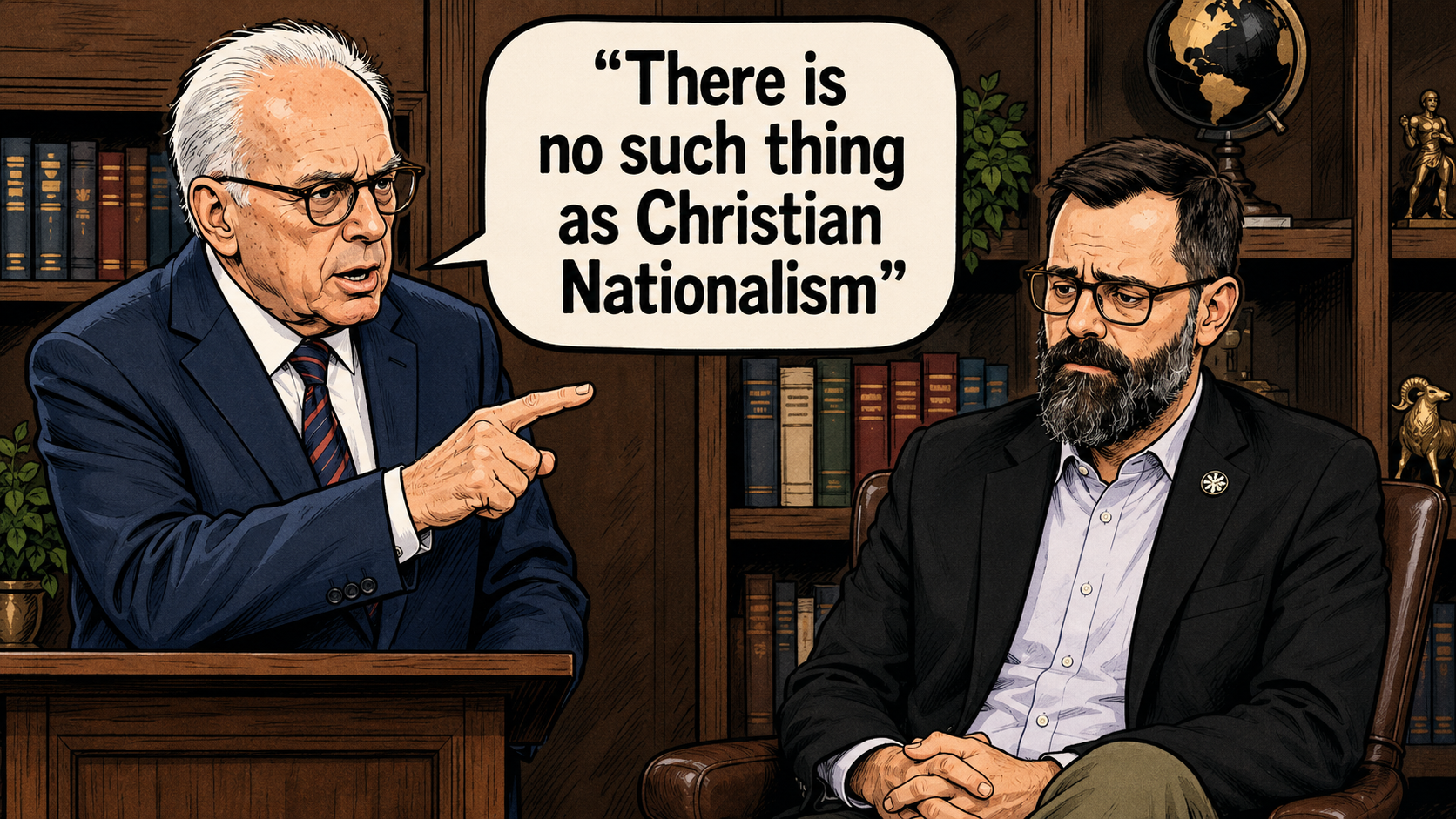
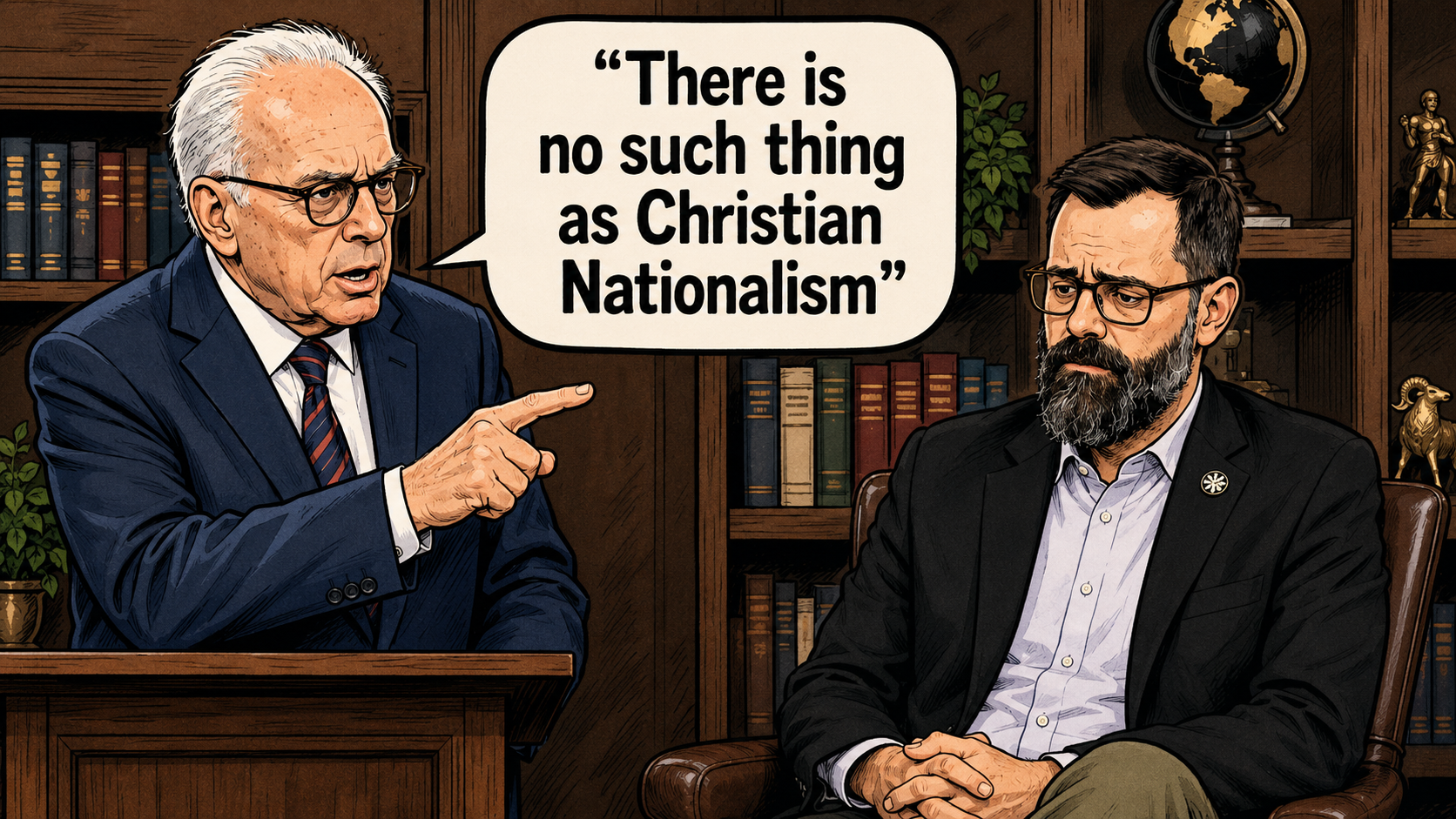
John MacArthur Schools Joel Webbon

In Joel Webbon’s recent “prophetic” fatwa against Phil Johnson, issued in retaliation for Johnson’s lecture criticizing Christian Nationalism, Webbon made a big to-do about John MacArthur’s faithfulness. He then attempted to portray Phil Johnson as dragging the church MacArthur once pastored into a dangerous stance that opposes the Great Commission.

Well, I found the receipts, and they prove otherwise.

Resources to Help You Fight Christian Nationalism and Defend Biblical Christianity

Here are a few resources to help you fight so-called “Christian” Nationalism and Defend Biblical Christianity as we fulfill the Great Commission by preaching the Gospel.

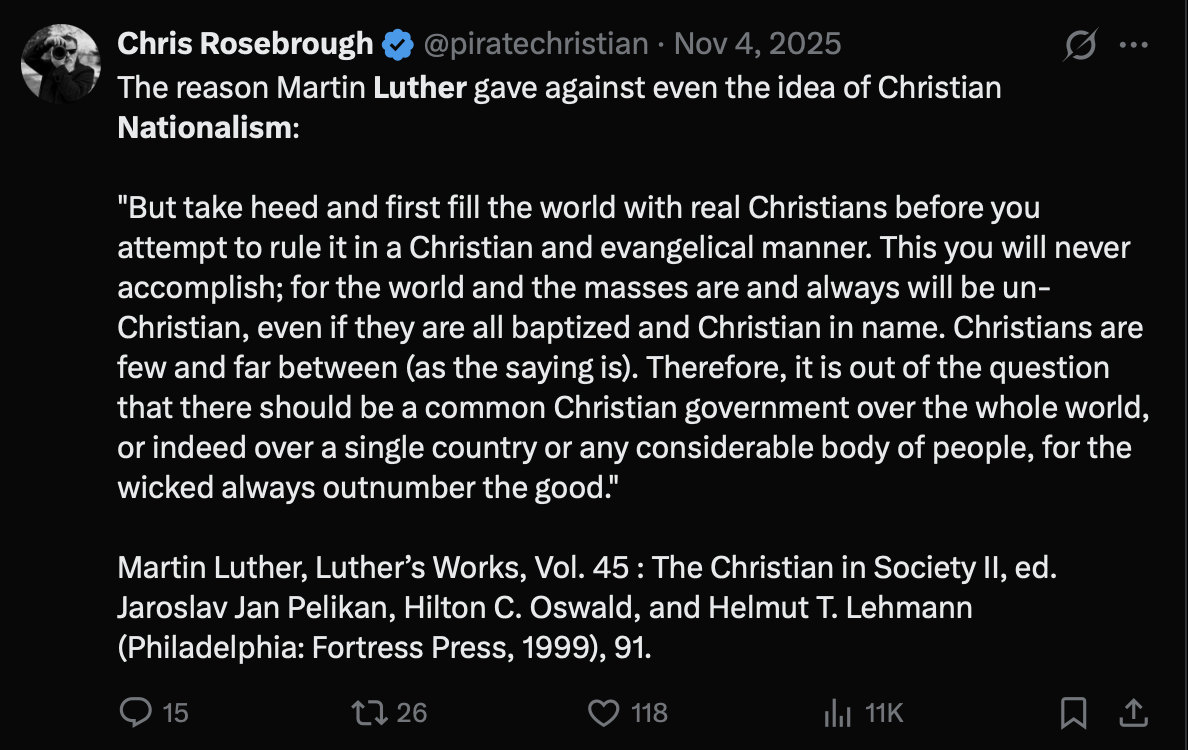
Here is a link, as promised, to Martin Luther’s “Secular Authority and to What Extent it Should Be Obeyed”. In this work, Martin Luther completely dismisses the idea of Christian Nationalism, and his reasoning makes perfect Biblical sense.

The Case Against Kathryn Krick and GeorDavie

Below are a series of videos that provide further receipts that GeorDavie, Kathryn Krick’s spiritual father, is a false prophet and a sexual predator.

Touch Not God's Anointed FREE MP3 Download

Touch Not God's Anointed
GeorDiddy and the Grifters

Please share this song with your friends and family.

Finding the Answers to the Tough Questions about John 5:1-17

Arguably, John 5:1–17 is one of the most difficult passages in Scripture to exegete correctly. There is little about this account that is easy to understand. Before the careful student of God’s Word can arrive at a faithful interpretation, he must first wrestle with several important questions.

What was this pool, and why were people suffering from serious physical maladies waiting for its waters to be stirred?

Why did the man who was healed shift the blame to Jesus when he was confronted for carrying his mat on the Sabbath?

Why did Jesus give the man such an ominous warning, telling him to sin no more lest something worse happen to him?

Why did the healed man report Jesus to the religious authorities, knowing that this could result in Jesus being persecuted?

Further complicating an already difficult text is the fact that a later scribal note concerning an angel stirring the waters of the pool found its way into some manuscripts, further obscuring an already challenging account.

It should also be noted that every faithful pastor must wrestle with these questions if he is to fulfill the duties of his office and rightly divide the Word of truth (2 Tim. 2:15). Those who have not done the necessary exegetical work (men like Mike Signorelli) will be readily apparent to those who have.

Below are resources to help answer some of these questions for those willing to put in the work.

What does recent archaeological scholarship say about the Pool of Bethesda

Here is an article from 2014 highlighting archaeological evidence that the Pool of Bethesda may have been a temple to Asclepius

Here is recent archaeological scholarship arguing that the Pool of Bethesda was a Jewish mikvah.

Here is a recent scholarly paper arguing that it was a temple to Asclepius at the time of Christ.

What is the Textual Evidence Against an Angel Stirring the waters of the Pool of Bethesda

This is a PDF of a scholarly journal article written by Gordon Fee titled “On the Inauthenticity of John 5:3b-4”. This article decisively demonstrates that reading is a later scribal note / gloss that crept into the later manuscripts.

Bonus Material:

This post was compiled to accompany an episode of Fighting for the Faith demonstrating that Mike Signorelli is not the kind of “pastor” who does his homework before preaching his “sermons.” For the record, he now claims to be an apostle.

Below is the episode in which I document Mike claiming to know Greek when he clearly does not.

In the episode below, Mike Signorelli tried to defend himself against my claim that he didn’t know Greek by claiming that he was correct but I was critiquing him by using “Lutheran Greek”. The section in question begins at 25:20 and ends at 40:12.

We're Still Waiting for that "Reverse Rapture" Thingy

Ahem….Hey Carolyn, you told us, quite a few days ago now, that the reverse rapture thingy that God supposedly told you about was going to happen “at any moment”…well, we’re still waiting…what’s the hold up?

0
Days Since Carolyn Dennis Claimed the Reverse Rapture would happen at "any moment"!

Maybe the reason why it’s taking so long for this ‘reverse rapture’ thingy to show up is that God didn’t tell Carolyn Dennis anything and she’s a false prophet.

What do you think?

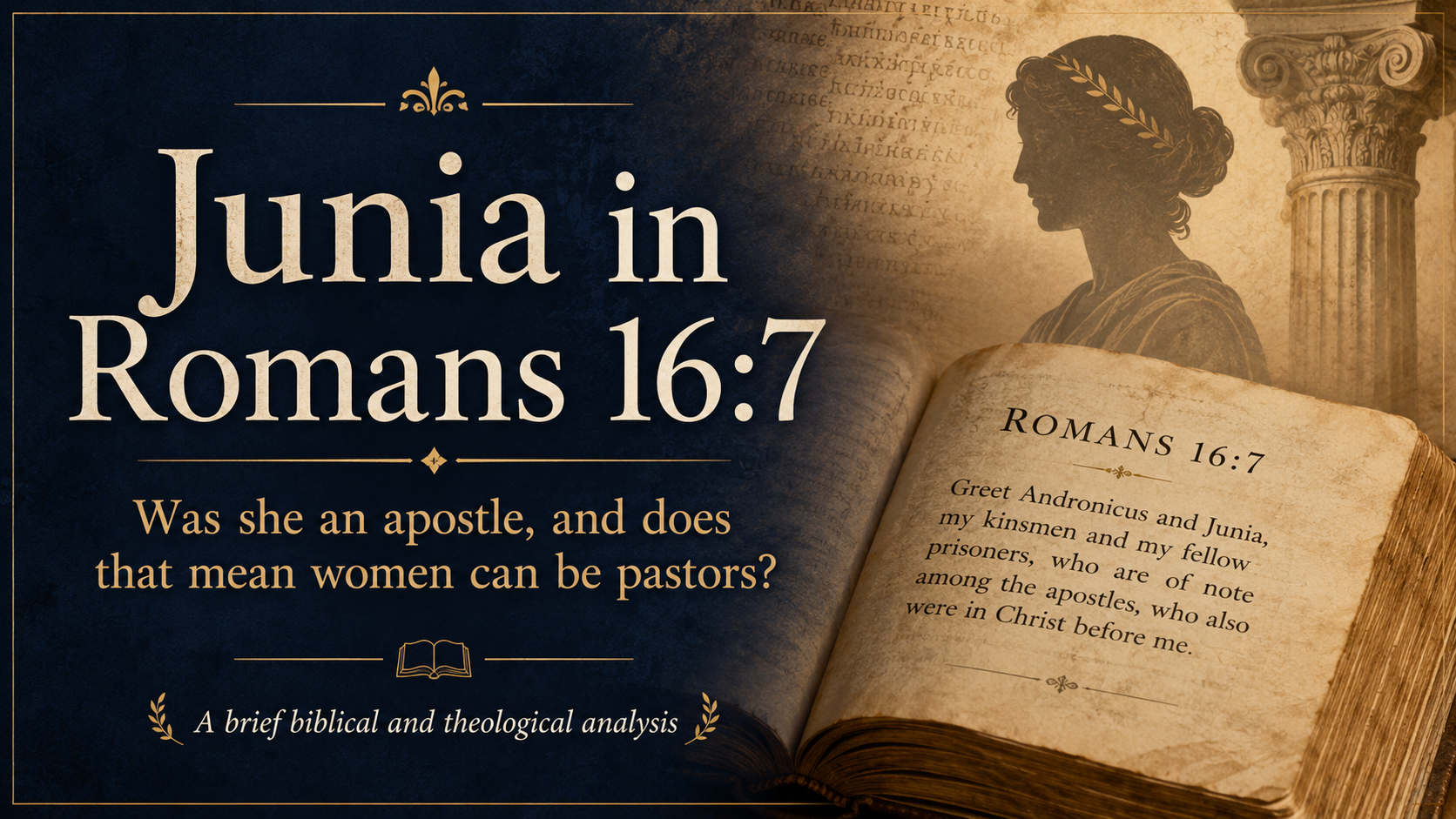
Junia in Romans 16:7: Was She an apostle, and does that mean women can be pastors?

Romans 16:7 is often cited as the knockout text proving that women may serve as pastors. Paul writes, “Greet Andronicus and Junia, my kinsmen and my fellow prisoners. They are well known among the apostles, and they were in Christ before me.” The argument usually goes like this: Junia was a woman. Junia was an apostle. Therefore, women may be pastors. But that conclusion far outruns the text.

Let us grant, for the sake of argument, that Junia was a woman. Let us also grant the stronger translation, that she was “notable among the apostles,” rather than merely “well known to the apostles.” Even when we grant these, Romans 16:7 simply does not say that Junia was a pastor, elder, overseer, or one called into the public preaching office of the church. And that matters.

The Greek word translated “apostle” is ἀπόστολος (apostolos). It means one who is sent. In the New Testament, the word is not always used in the narrow technical sense of the Twelve or Paul, who were directly called by Christ as foundational witnesses of His resurrection. Oftentimes the word ἀπόστολος is used more broadly for a messenger, envoy, delegate, or missionary representative of the churches.

For example, in 2 Corinthians 8:23, Paul speaks of certain brothers as ἀπόστολοι ἐκκλησιῶν, “apostles of the churches,” or “messengers of the churches.” These men were sent by congregations. They were emissaries. They were not apostles in the same sense as Peter, John, or Paul. Likewise, in Philippians 2:25, Paul calls Epaphroditus ὑμῶν δὲ ἀπόστολον, “your apostle,” or “your messenger.” Again, Epaphroditus was sent by the Philippian church. He was not one of the Twelve. He was not Paul. He was a delegated messenger.

So when we come to Romans 16:7 and see the phrase ἐπίσημοι ἐν τοῖς ἀποστόλοις, “notable among the apostles,” we still have to ask a very basic question: apostle in what sense? Was Junia being identified as one of the foundational apostles of Christ, equal to the Twelve and Paul? The text does not say that nor does it permit that. Was Junia, then associated with a broader group of missionary workers, messengers, and sent ones known in the early church? That is the only other valid option available to us and that is a far cry from saying Junia was a pastor.

That is the category error in the modern argument. It moves from “Junia was prominent in apostolic Christian service” to “Junia held the pastoral office.” But Romans 16:7 never says that. Paul honors many women in Romans 16. Phoebe is called a servant of the church. Priscilla is a fellow worker. Mary worked hard. Tryphaena, Tryphosa, and Persis labored in the Lord. Junia suffered for Christ and was known among, or to, the apostles. These women were faithful, courageous, useful, and honored servants of Christ. Amen. But none of that is the same thing as saying they were ordained pastors.

The New Testament does not confuse Christian service with the pastoral office. All Christians serve. All Christians confess Christ. All Christians bear witness. Many Christians teach in proper settings. Some are sent as messengers. Some support the mission. Some suffer for the Gospel. But the public preaching office is treated as a distinct office.

When Paul gives the qualifications for the overseer in 1 Timothy 3 and Titus 1, he does not point us to Romans 16. He speaks of an ἐπίσκοπος, an overseer, who is to be μιᾶς γυναικὸς ἄνδρα, “the husband of one wife.” In 1 Timothy 2, Paul says, διδάσκειν δὲ γυναικὶ οὐκ ἐπιτρέπω, “I do not permit a woman to teach,” and then adds, οὐδὲ αὐθεντεῖν ἀνδρός, “or to exercise authority over a man.” Paul grounds this not in local culture, not in Roman patriarchy, not in Ephesian weirdness, but in creation: Ἀδὰμ γὰρ πρῶτος ἐπλάσθη, εἶτα Εὕα, “For Adam was formed first, then Eve.” That is the sedes doctrinae.

Clear texts govern unclear texts. Romans 16:7 is not the sedes doctrinae for the pastoral office. It is a greeting. A beautiful greeting. An important greeting. A text that shows us how highly Paul valued faithful women who labored and suffered for the Gospel. But it does not establish women’s ordination.

So the real question is not, “Was Junia important?” Of course she was. The question is not, “Did Junia serve Christ?” Of course she did. The question is not, “Can women be brave, faithful, doctrinally sound, sacrificial, and useful in the work of the Gospel?” Of course they can. The question is whether Romans 16:7 overturns Paul’s explicit teaching regarding the public teaching office of the church. And the answer is a resounding no.

Junia may have been notable among the ἀπόστολοι. But ἀπόστολος does not automatically mean pastor. And Romans 16:7 does not authorize what 1 Timothy 2 and 3 forbid. That is not an insult to Junia. It is simply letting Scripture speak with precision.

All the Receipts that Prove Kathryn Krick is Guilty of Being a False Apostle

Kathryn Krick has recently made national headlines with a very truthful write up about her and her cult in the NYPost. (Link Here)

We’ve been warning the body of Christ and the world about this very dangerous woman for more than five years. Here is a handy-dandy compilation of our videos proving, beyond a shadow of a doubt, that this woman is a wolf and false apostle.

Troy Black’s Fulfilled Prophecy Archive Proves He's a False Prophet

Troy Black claims that God regularly speaks to him and reveals future events concerning presidents, governments, elections, diseases, natural disasters, public figures, and events that will soon appear in the news.

These are not merely personal impressions that Troy keeps to himself.

He publishes them.

He places them before the Church.

He says they came from God.

And to prove that he possesses a genuine prophetic gift, Troy Black’s ministry has created an online archive entitled “All Fulfilled Prophecies.”

At first glance, this sounds commendable. After all, those who claim to speak for God should welcome accountability. If Troy Black is receiving genuine revelations from the Holy Spirit, then the record should demonstrate that the events he predicted occurred as he said they would.

But that is not what this archive demonstrates.

Not even close.

Instead, the archive is a hot mess of vague predictions, moved timelines, symbolic substitutions, verbal coincidences, retroactive interpretations, partial correspondences, and events that do not match what Troy originally said.

Some of the prophecies listed as fulfilled contain major details that never occurred.

Some are connected to events that happened before Troy published the prophecy.

Some predictions are declared fulfilled because the predicted event was prevented and therefore never took place.

Some prophecies are assembled from several unrelated news reports because no single event matches the original prediction.

Some are still waiting for essential details to unfold, yet they have already been placed in the fulfilled column.

And some of Troy’s alleged prophecies did not predict anything at all.

This archive does not establish that Troy Black possesses a genuine prophetic gift.

It demonstrates how prophetic claims can be protected from ever being declared false.

What Would Real Prophetic Accountability Look Like?

Before examining Troy’s claims, we need to establish what an honest prophecy archive should contain.

It should contain every prophecy Troy has publicly given, not merely those that someone believes can be connected to later events.

It should preserve the complete original wording.

It should identify the date when the prophecy was first made publicly available, not the date Troy claims he received the prophecy.

It should state what specific event(s) was predicted, where it would occur, and when it would occur.

It should identify the details that must happen for the prophecy to be considered fulfilled.

It should also identify the details that would demonstrate that the prophecy failed. Falsifiability matters because a prophecy that cannot possibly be proven false cannot meaningfully be verified as true. If every conceivable outcome can be reinterpreted as fulfillment, then the prophecy cannot be tested according to the biblical standards laid out in Scripture.

And when a prophecy does fail, the archive should say so.

That is what real accountability looks like.

Troy Black’s archive does something altogether different.

It begins with the conclusion that a prophecy has been fulfilled and then searches through later news reports, social media posts, political controversies, weather events, rumors, threats, and verbal similarities for something that can be connected to Troy’s words.

The archive repeatedly uses expressions such as “may refer to,” “could be connected,” “possibly marks the beginning,” “it is unclear,” “there may be more,” and “we will update this if more unfolds.”

Those are the words of speculation.

They are not the words of fulfillment.

A prophecy has not been fulfilled merely because someone found a later news report containing one or two words that sound similar to something Troy said.

God does not need a team of interpreters to rummage through news reports and manufacture correspondences on His behalf.

When God speaks, His Word is true.

Here are just of few of the so-called “fulfilled” prophecies listed on Troy’s website that clearly are not fulfilled.

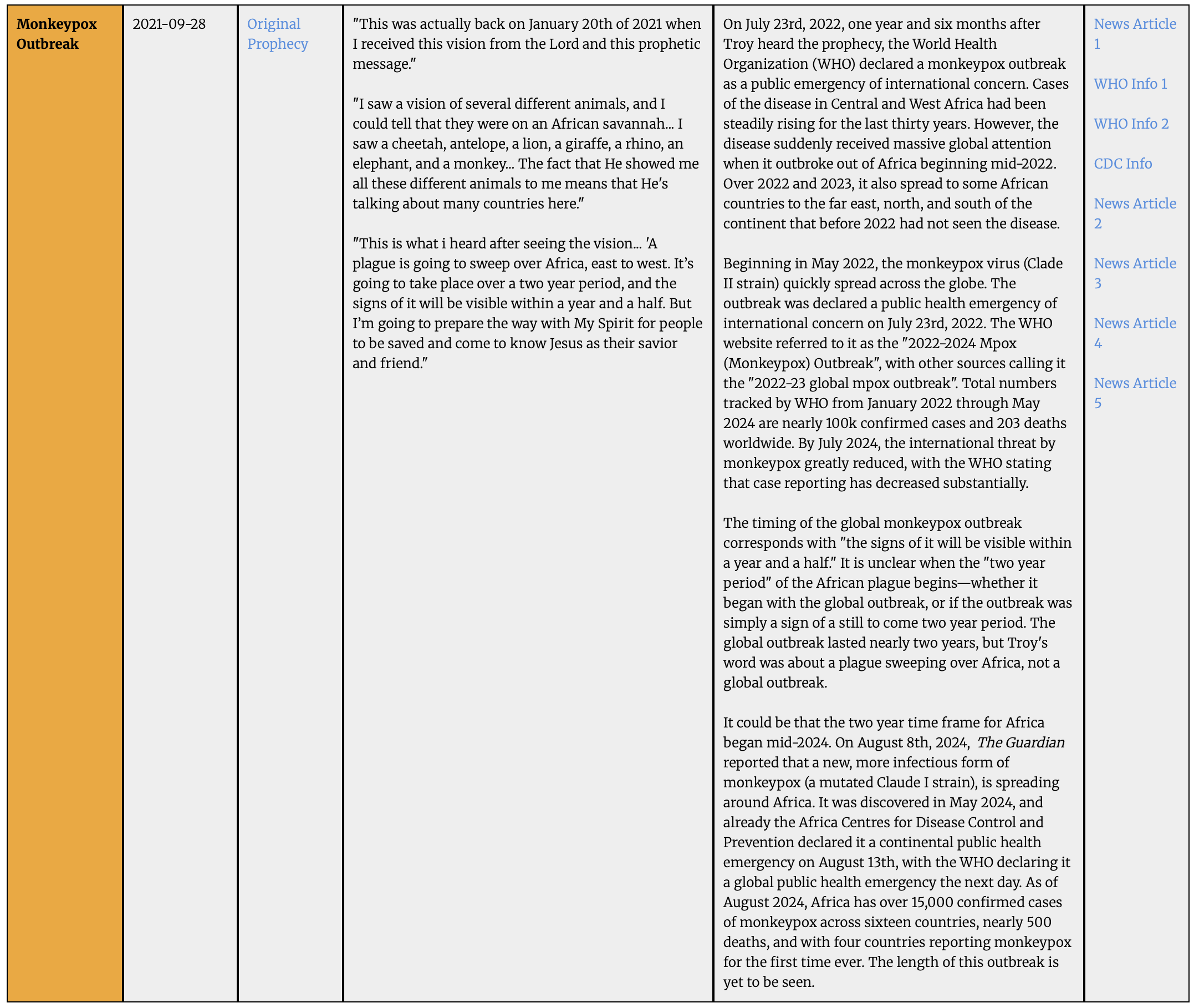
The African Plague

Troy Black claims that he received a prophetic word concerning Africa on January 20, 2021. He publicly shared it on September 28, 2021.

Troy said:

“A plague is going to sweep over Africa, east to west. It’s going to take place over a two year period.”

This prophecy is not difficult to understand.

Troy predicted a plague.

The plague would sweep across Africa.

It would move from east to west.

It would take place over two years.

Those are the specifics of the prophecy.

The archive claims that this prophecy was fulfilled by the worldwide outbreak of monkeypox, which is now commonly called mpox.

But here is the problem.

The archive itself admits that Troy’s word concerned a plague sweeping across Africa, not a worldwide outbreak.

That should have ended the discussion.

The event did not match the prophecy.

Instead, the archive proposes that the worldwide outbreak may have been an early stage of a later African outbreak. It then suggests that the two year period Troy predicted might have begun during the middle of 2024.

That is several years after Troy says he received the word.

The archive also acknowledges that the duration of the African outbreak remained unknown.

So what exactly was fulfilled?

The archive did not establish that a plague swept across Africa from east to west.

It did not establish that the event occurred over the predicted two year period.

It did not identify when that period began.

It first pointed to a worldwide outbreak, then admitted that Troy predicted an African outbreak, and then moved the beginning of the timeline several years into the future.

This is not fulfillment.

This is an unresolved prophecy that has been placed in the fulfilled column.

There is also a serious dating problem.

Troy claims that he received this word privately on January 20, 2021, but he did not publicly share it until September 28, 2021.

That does not prove that Troy fabricated the earlier date. But unless he can produce an independently timestamped record from January 2021, the earlier date cannot be publicly verified.

For accountability purposes, the prophecy begins on the date when outsiders can confirm that it existed.

That date is September 28, 2021.

A private date supplied after the fact cannot carry the same evidentiary weight as a publicly accessible recording.

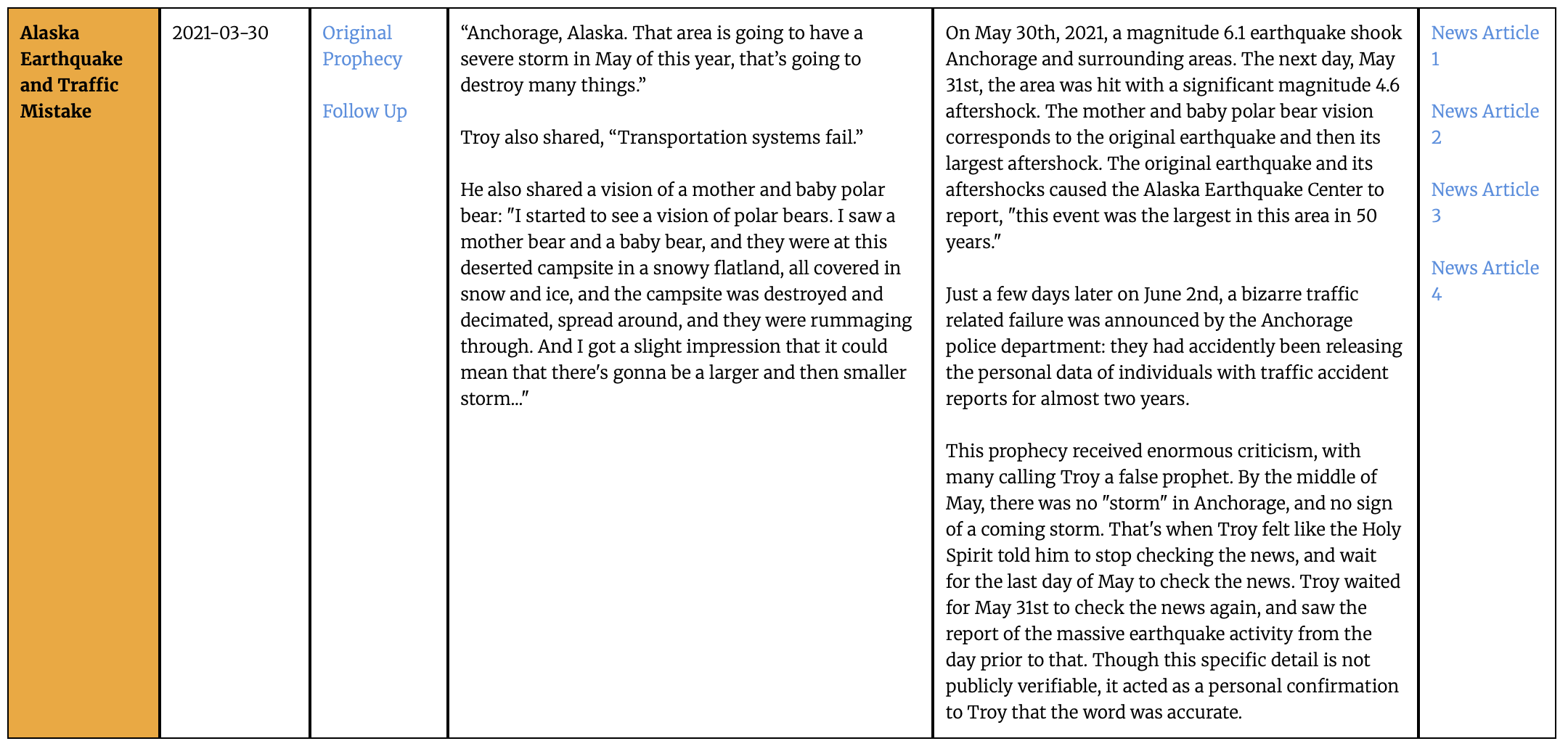
The Anchorage Storm That Became an Earthquake

Troy publicly shared this prophecy on March 30, 2021, although he claimed that he had received the initial word on March 8.

He said:

“Anchorage, Alaska. That area is going to have a severe storm in May of this year, that’s going to destroy many things.”

He also said:

“Transportation systems fail.”

The following day, Troy claimed that he saw a vision involving a mother polar bear and her cub rummaging through a deserted campsite that had been destroyed and scattered across a snowy and icy landscape. He then offered what he called a “slight impression” that this might signify a larger storm followed by a smaller storm, or possibly two different events occurring at the same time.

Unlike many of Troy’s prophecies, this one was remarkably testable.

The location was Anchorage, Alaska.

The event was a severe storm.

The timeframe was May 2021.

The storm would destroy many things.

Transportation systems would fail.

The vision also depicted snow, ice, a destroyed campsite, and polar bears rummaging through the devastation.

There was no need to wait several years for a possible interpretation. May 2021 would either bring the destructive Anchorage storm Troy predicted, or it would not.

It did not.

At Fighting for the Faith, we monitored Anchorage throughout the month. Viewers sent weather reports. We examined historical weather data. We watched publicly available cameras showing downtown Anchorage, the airport, and the Lake Hood seaplane base. The transportation systems continued operating, aircraft continued taking off and landing, and the severe storm never arrived.

The original prophecy did not merely predict some kind of unusual event in Alaska. Troy specifically said that Anchorage would experience a severe storm during May 2021 that would destroy many things and cause transportation systems to fail. His own published words clearly identified the expected event.

The weather data showed no such devastation. Anchorage experienced no major snow or ice storm, no destruction of many things, and no failure of its transportation systems. Even the largest flooding event in Alaska that month occurred in Buckland, nearly five hundred miles away from Anchorage.

This prophecy failed.

But Troy’s archive now claims that it was fulfilled.

How?

By replacing the severe storm with an earthquake.

On May 30, 2021, a magnitude 6.1 earthquake occurred near Anchorage, followed the next day by a magnitude 4.6 aftershock. The archive claims that the mother and baby polar bears corresponded to the larger earthquake and its smaller aftershock.

But Troy did not prophesy an earthquake.

He prophesied a storm.

Earthquakes and storms are not interchangeable events. One is caused by movement within the earth’s crust. The other is an atmospheric weather event. Troy even described snow, ice, a devastated campsite, and the expectation of one or perhaps two storms.

The archive has not interpreted Troy’s prophecy.

It has replaced it.

The archive also claims that Troy’s words concerning transportation systems were fulfilled by a June 2 announcement from the Anchorage Police Department. The department admitted that it had accidentally released personal information in traffic accident reports for nearly two years.

But this was not a failure of Anchorage’s transportation systems.

No buses stopped running.

No roads failed.

No airport shut down.

No seaplanes were grounded.

No transportation infrastructure collapsed.

A police department made a data privacy error involving traffic accident reports. The fact that the reports concerned traffic does not transform an administrative mistake into the failure of transportation systems.

This is another verbal substitution.

“Transportation systems fail” becomes “the police mishandled information contained in traffic reports.”

The words sound vaguely related because both involve traffic. But they describe entirely different things.

The archive’s treatment of the polar bears is equally strained.

Troy saw a mother bear and her cub in a destroyed, snow covered campsite. The archive now says that the two bears represented a large earthquake and a smaller aftershock.

Why?

Nothing in Troy’s prophecy connected polar bears with earthquakes. Nothing in the vision identified the mother bear as a mainshock or the cub as an aftershock. That meaning was supplied only after the earthquakes occurred.

Had Anchorage experienced two storms, the bears could have represented two storms.

Had two transportation failures occurred, they could have represented those.

Had two public officials resigned, two buildings collapsed, or two unusually cold weather events occurred, the archive could have assigned the bears to those instead.

The interpretation is not derived from the prophecy. It is imposed upon it afterward.

The archive even acknowledges that by the middle of May there had been no storm and no sign that one was coming. According to its own account, Troy then felt that the Holy Spirit told him to stop checking the news and wait until the final day of May.

That private impression is not publicly verifiable.

More importantly, it does not change what Troy originally predicted.

The prophecy concerned a destructive storm in Anchorage during May.

No destructive storm occurred.

Waiting until the end of the month and discovering an earthquake does not turn an earthquake into a storm.

Nor does Troy’s personal feeling of confirmation establish that the word came from God. Personal confirmation is the very thing being tested. A claimant cannot use his own inner conviction as proof that his failed public prediction was secretly accurate.

This entry may be the clearest example in the entire archive of a failed prophecy being rewritten after the deadline.

The predicted event was a storm.

The archive substituted an earthquake.

The predicted failure involved transportation systems.

The archive substituted a police department’s release of personal data in traffic reports.

The polar bears were part of a snowy campsite vision.

The archive converted them into an earthquake and its aftershock.

None of these substitutions comes from Troy’s original words.

They were added after the prophecy failed.

The archive does not demonstrate that Troy accurately predicted an earthquake. It demonstrates that once the severe storm failed to occur, his ministry searched through the remaining news from Anchorage and found an unrelated event that could be placed inside the empty shell of the prophecy.

This is precisely why falsifiability matters.

The Anchorage prophecy was falsifiable. It identified a location, an event, and a deadline. Anchorage would experience a destructive severe storm during May 2021, or it would not.

It did not.

But rather than accept the result of the test, the archive changed the terms after the test was over.

That is not fulfillment.

That is the refusal to admit failure!

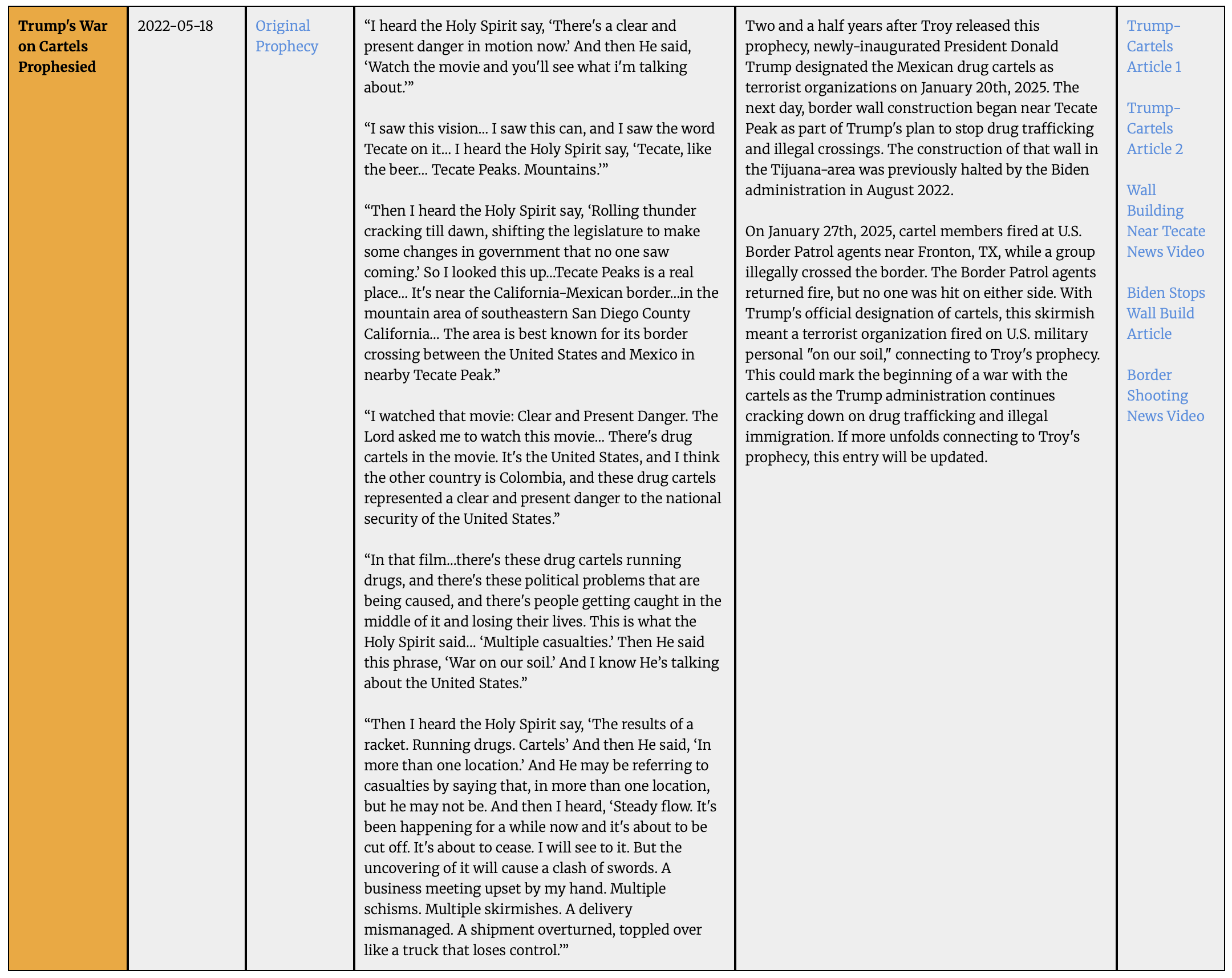
War With the Cartels on American Soil

Troy publicly shared this prophecy on May 18, 2022.

He predicted a conflict involving the drug cartels and used several specific expressions:

“Multiple casualties.”

“War on our soil.”

“It’s about to cease.”

The archive later pointed to an incident in which cartel members fired at United States Border Patrol agents.

But nobody was struck.

There were no multiple casualties.

There was no demonstrated war on American soil.

The cartel drug trade did not cease.

The event did not match the prophecy.

The archive nevertheless suggested that the incident “could mark the beginning” of a war with the cartels and stated that the entry could be updated if more events occurred.

Read that again.

The archive calls the prophecy fulfilled while simultaneously admitting that the event may merely be the beginning of something that might fulfill the prophecy later.

A possible beginning is not a fulfillment.

If the archive must wait for the predicted event to occur, then the prediction has not been fulfilled.

This should not be difficult.

But once the archive has committed itself to proving Troy’s accuracy, even an event without casualties can be used to fulfill a prophecy of multiple casualties.

Even an isolated exchange of gunfire can be turned into a war.

And even a drug trade that continues can be connected to the declaration, “It’s about to cease.”

Words no longer possess stable meanings.

They become pieces of clay that can be reshaped after the event.

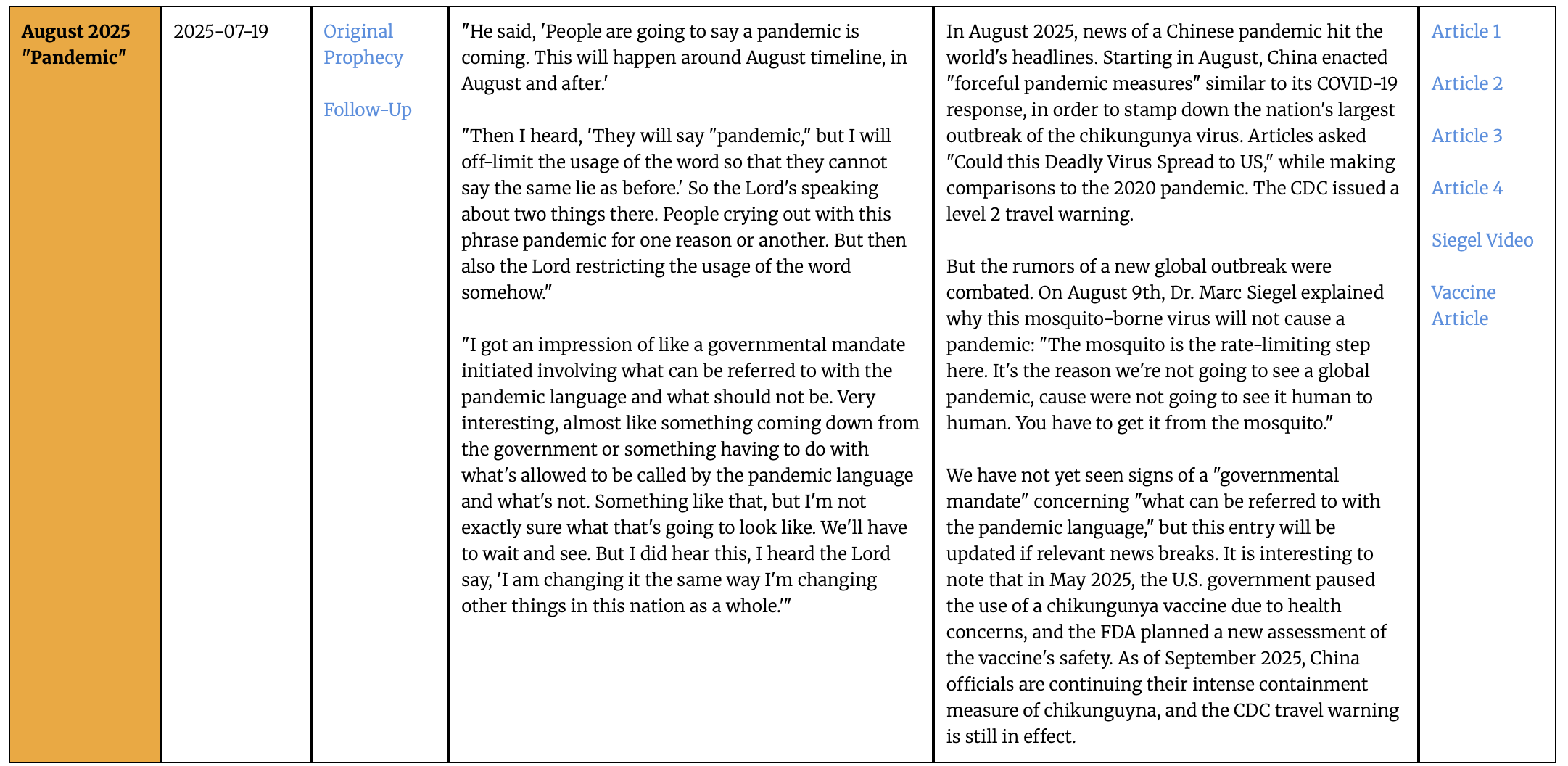
The August Pandemic Language Mandate

Troy shared this prophecy on July 19, 2025.

He predicted that around August people would begin speaking about a pandemic. He also predicted that some form of government mandate would restrict or regulate what could be described using pandemic language.

The archive connected this prediction to an outbreak of chikungunya in China.

But then the archive admitted:

“We have not yet seen signs of a governmental mandate concerning what can be referred to with the pandemic language.”

There it is.

The archive openly admits that a central part of Troy’s prediction did not happen.

Yet the prophecy remains in a catalog of fulfilled prophecies.

The government mandate was not a minor detail supplied by an overenthusiastic interpreter. It was part of Troy’s prophecy.

No mandate was identified.

Therefore, the prophecy was not fulfilled.

The archive’s own words establish this.

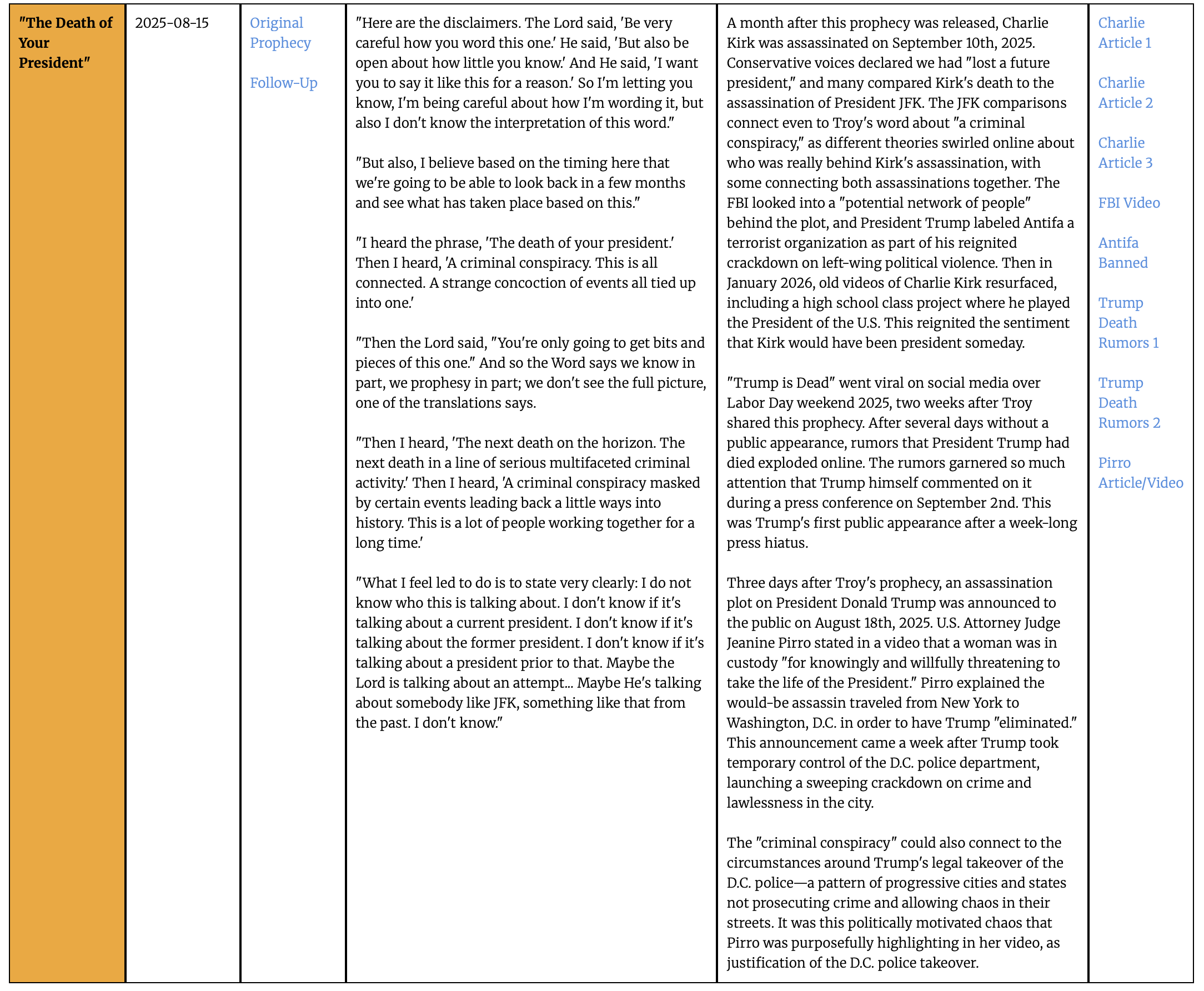
“The Death of Your President”

Troy shared this prophecy on August 15, 2025.

He said that he heard the phrase:

“The death of your president.”

He also indicated that within a few months people would be able to look back and recognize what had occurred. The prophecy included references to criminal conspiracy, interconnected events, and a coming death.

But no president died.

That fact should settle the matter.

Instead, the archive offered several possible substitutes.

One proposed fulfillment involved the death of Charlie Kirk and the idea that some people thought he might become president someday.

Another involved false rumors on the internet claiming that President Donald Trump had died.

Another involved a woman who was arrested for threatening Trump.

Another relied upon comparisons between Charlie Kirk and President John F. Kennedy.

But Charlie Kirk was not the president.

He had never been president.

The fact that some people may have imagined a possible future presidential campaign does not make him “your president.”

A false rumor that President Trump died is not the death of President Trump.

A threat against a president is not the death of a president.

A comparison between Charlie Kirk and John F. Kennedy is not the death of your president.

None of these events fulfills Troy’s words.

Rather than admit that the predicted death did not occur, the archive gathers a pile of associations involving death, presidents, threats, rumors, and possible future political careers.

The meaning of the original prophecy is dissolved.

“Your president” can mean the actual president.

Or it can mean someone who might have become president.

Or it can mean a former president.

Or it can mean someone compared to a president.

“Death” can mean an actual death.

Or a rumor of death.

Or a threat of death.

Or the death of someone else.

Once words are allowed to move that freely, no testable prophecy remains.

Everything means something else.

And anything can fulfill anything.

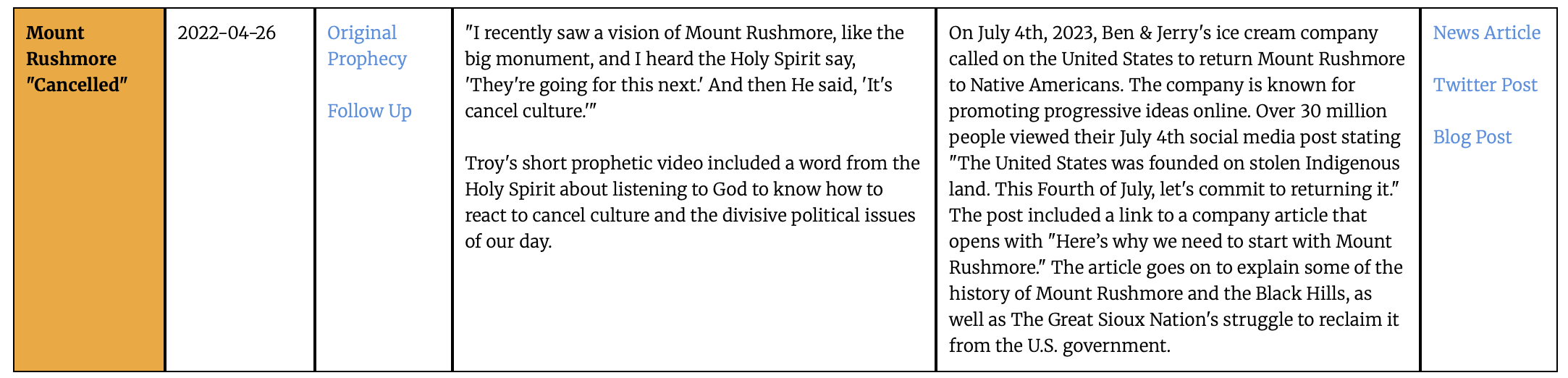
Mount Rushmore and Cancel Culture

Troy shared this prophecy on April 26, 2022.

Speaking about Mount Rushmore, he said:

“They’re going for this next.”

“It’s cancel culture.”

The archive claims that this prophecy was fulfilled when Ben and Jerry’s published a statement on July 4, 2023, calling for the land associated with Mount Rushmore to be returned to Native Americans.

But nothing happened to Mount Rushmore.

The monument was not removed.

It was not renamed.

It was not closed.

It was not scheduled for destruction.

No new law was passed against it.

No government agency announced a plan to dismantle it.

A politically progressive ice cream company expressed a political opinion.

That is all.

One may agree or disagree with the statement. But the publication of an opinion by Ben and Jerry’s does not establish that Mount Rushmore was being cancelled.

The original wording was also hopelessly vague.

Who are “they”?

What does “going for this” mean?

Does it mean criticism?

Does it mean removal?

Does it mean transferring ownership of the land?

Does it mean renaming the monument?

Does it mean publishing a social media post?

What event would prove that the prophecy failed?

The archive does not tell us.

“They’re going for this next” is so indefinite that any future criticism from any politician, activist, company, academic, journalist, or social media account can be placed inside it.

This is not impressive.

It is not even difficult.

Mount Rushmore has been the subject of political controversy for decades. Predicting that someone on the political left would criticize it is about as remarkable as predicting snow in North Dakota during winter.

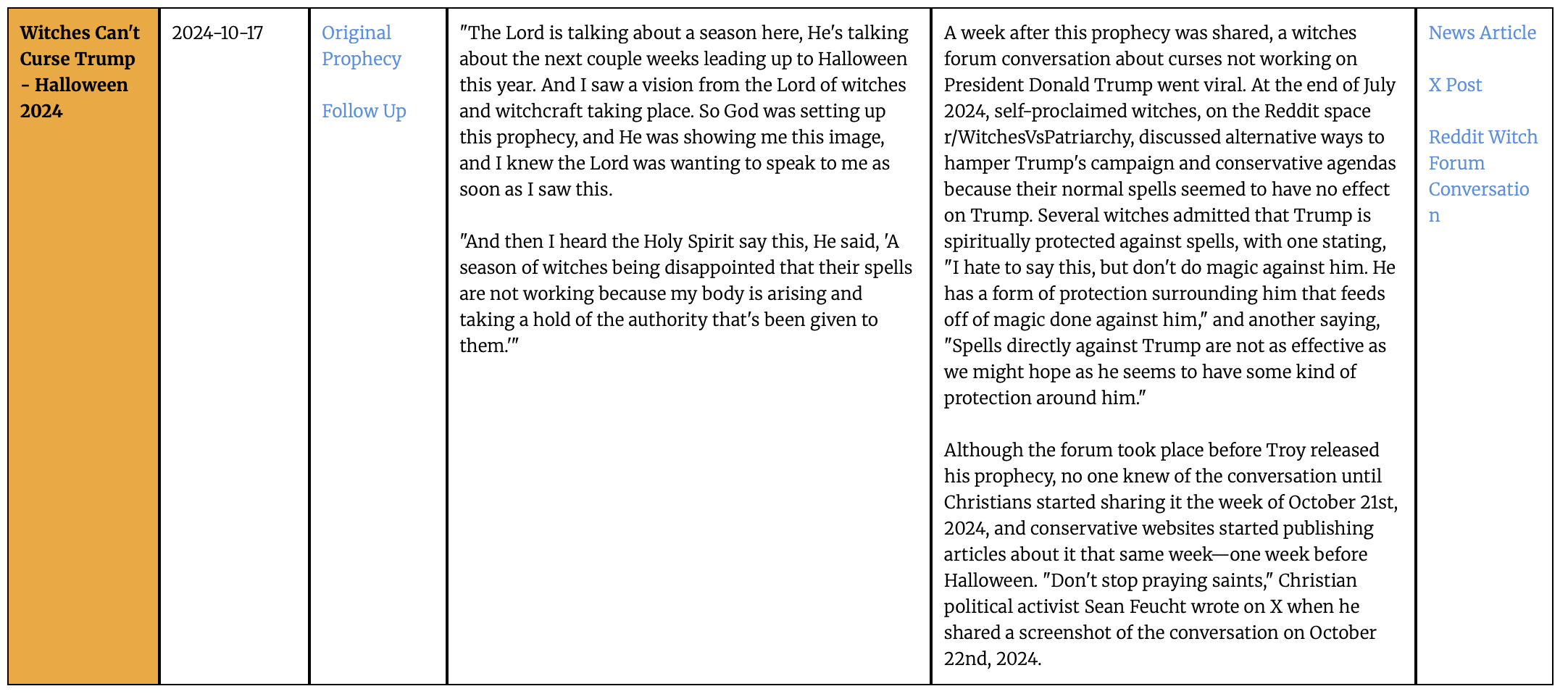
Witches Disappointed Before Halloween

Troy shared this prophecy on October 17, 2024.

He predicted a season leading into Halloween in which witches would become disappointed because their spells were failing.

The archive connected this to an online discussion among people who described themselves as witches and complained that their spells against Donald Trump were not working.

There is only one small problem.

The discussion took place at the end of July 2024.

That was roughly two and a half months before Troy published the prophecy.

The alleged fulfillment happened first.

The prophecy came later.

The archive attempted to rescue the claim by arguing that Christians did not widely circulate the discussion until after Troy published his prophecy.

But Troy did not predict that Christians would later discover an old internet conversation.

He predicted that witches would become disappointed leading into Halloween.

The disappointment had already occurred.

The event cannot prove Troy predicted the future because it was already in the past.

The same problem appears in an archive entry involving Sesame Street. The news article identified as the fulfillment had been published before Troy released the alleged prophecy. The archive’s explanation was that the story received greater public attention afterward.

But later attention does not turn an earlier event into a fulfilled prophecy.

Suppose I read an obscure news article this morning. Tomorrow I publish a prophecy describing the contents of the article. Then, two weeks later, the story becomes nationally prominent.

Did I predict the future?

Of course not.

I described something that had already happened.

The later popularity of the story does not transform my description into prophecy.

The Bomb That Would Rattle a Nation

Troy says he received this word on October 7, 2024, and publicly shared it on November 16, 2024.

He predicted:

“A bomb is going to go off that will rattle a nation.”

He added:

“The effects of it, in a societal way, will be massive.”

Again, the words are understandable.

A bomb would explode.

The explosion would rattle a nation.

Its social effects would be massive.

The archive offered several possible fulfillments.

One involved bomb threats in which no bombs were found.

But a bomb threat is not a bomb going off.

Another involved a Tesla explosion that authorities described as an isolated event.

But an isolated vehicle explosion does not fulfill the prediction of an event producing massive societal consequences.

Another proposed fulfillment involved a weather system described as a “bomb cyclone.”

This is nothing more than a pun.

A bomb cyclone is a meteorological term. No explosive device detonates. There is no political bombing. There is no terrorist attack. The presence of the word “bomb” does not transform a weather report into the fulfillment of a prophecy that a bomb would go off.

Once again, the archive stated that there “may be more” and that the entry could be updated as further events unfolded.

In other words, the archive does not know what fulfilled the prophecy.

It is still looking.

Yet the prophecy is already listed as fulfilled.

This is backwards.

You do not declare a prophecy fulfilled and then continue searching for its fulfillment.

How the Troy’s “Fulfilled Prophecy Archive” Manufactures Fulfillments

The problems in these entries are not random.

A clear method emerges.

The archive begins with the assumption that Troy heard from God. It then interprets every prophecy in a way that preserves that assumption.

When the prediction does not match the event, the meaning of the prediction changes.

When the date does not match, the timeline moves.

When the central event does not occur, a threat or rumor becomes the fulfillment.

When no single event matches the prophecy, several unrelated events are gathered together.

When the alleged fulfillment happened before the prophecy, later publicity becomes the fulfillment.

When a prophecy remains incomplete, the archive declares it fulfilled and promises future updates.

The archive does not test Troy’s claims.

It protects them.

The Central Words Are Replaced

“The death of your president” becomes the death of Charlie Kirk, a rumor about President Trump, a threat against Trump, or a comparison to John F. Kennedy.

“Multiple casualties” becomes an incident in which nobody was hit.

“War on our soil” becomes an exchange of gunfire.

“An explosion” becomes a prevented explosion.

“A bomb” becomes a bomb threat or a meteorological expression.

The emotional force of Troy’s original language is retained while the actual meaning is replaced.

This allows the prophecy to sound dramatic when Troy gives it and become elastic when it is tested.

That is very convenient.

But it is not prophecy.

Several Unrelated Events Are Combined

Again and again, the archive takes individual details from unrelated stories and combines them.

One story supplies the location.

Another supplies a key word.

Another supplies the political theme.

Another supplies the time of year.

Another supplies the name of a public figure.

No single event fulfills the whole prophecy.

But when all the stories are placed beside each other, the collection creates the impression that Troy said something remarkable.

He did not.

A prophecy containing five details is not fulfilled because five unrelated events each contain one of those details.

If I predict that a red truck will crash into a grocery store in Minnesota on Christmas Eve and injure twelve people, that prophecy is not fulfilled because a blue car crashed in Minnesota, a truck crashed in Iowa, a grocery store caught fire in Texas, and twelve people were injured in Florida.

The predicted event must occur.

Collecting disconnected similarities does not make it so.

Literal and Symbolic Language Are Switched at Will

The archive moves between literal and symbolic meanings whenever necessary.

When a literal prediction fails, it becomes symbolic.

Death becomes a rumor of death.

War becomes tension.

A president becomes someone who might someday seek the presidency.

An explosion becomes a prevented explosion.

But when a symbolic expression appears in a news report, the archive treats it literally.

A “bomb cyclone” becomes important because Troy used the word “bomb.”

This allows the archive to interpret Troy’s words in opposite directions depending upon what later events require.

Literal when convenient.

Symbolic when necessary.

And always fulfilled.

Timelines Are Moved

Dates and timeframes are essential when testing predictive claims.

Without them, an archive can wait indefinitely for something vaguely similar to happen.

Troy’s African plague was supposed to unfold over two years. When the proposed event did not match the prophecy, the archive suggested that the two year period may have begun several years later.

Events predicted around one season can be connected to developments months afterward.

Unresolved prophecies remain open indefinitely.

Private dates, which outsiders cannot independently verify, are sometimes treated as the beginning of the prophetic clock.

A deadline that can be moved is not a deadline.

And a prophecy that can remain open forever can never fail.

Events That Happened First Are Called Fulfillments

The witchcraft discussion happened before Troy published the prophecy.

The Sesame Street article appeared before the alleged prophetic word was released.

The archive attempts to solve this problem by pointing to later publicity.

But publicity is not the event.

A prophecy cannot predict something that has already happened unless the prophecy specifically predicts that the prior event will later be discovered or publicized.

Troy did not say, “An old conversation among witches will soon be discovered and circulated by Christians.”

He predicted the disappointment of witches leading into Halloween.

The disappointment had already occurred.

That is not foreknowledge.

That is afterknowledge.

Opposite Outcomes Both Prove the Prophecy

This may be the most serious problem of all.

If an explosion occurs, the prophecy is fulfilled.

If authorities stop the explosion, the prophecy is fulfilled.

If a bomb explodes, the prophecy is fulfilled.

If someone merely threatens to use a bomb, the prophecy is fulfilled.

If no bomb exists but a weather system is called a bomb cyclone, the prophecy is fulfilled.

If a president dies, the prophecy is fulfilled.

If a president does not die but rumors circulate that he died, the prophecy is fulfilled.

If no president dies but someone who might hypothetically have run for president dies, the prophecy is fulfilled.

Do you see the problem?

There is no possible outcome that requires the archive to admit that Troy was wrong.

That means the prophecies are not being tested.

They have been insulated from testing.

Selective Reporting Cannot Establish Accuracy

An archive of alleged successes cannot prove prophetic accuracy unless it also includes the failures.

How many prophetic words has Troy given?

How many contained specific, testable claims?

How many expired without fulfillment?

How many remain unresolved?

How many were reinterpreted after the fact?

How many depended upon symbolic meanings not stated in the original prophecy?

How many were matched to events that occurred before the prophecy?

How many apparent fulfillments would be expected by chance because of the sheer number and vagueness of Troy’s predictions?

The archive does not tell us.

Instead, it presents a selected group of alleged successes and declares that they prove Troy’s consistent accuracy.

Imagine an archer who fires hundreds of arrows into the side of a barn.

Afterward, he walks over to the barn and paints a bullseye around every cluster of arrows.

Then he photographs the targets and creates a website celebrating his remarkable skill.

Would that prove he was an expert marksman?

Of course not.

He did not hit the targets.

He painted the targets around the places where his arrows happened to land.

That is what Troy Black’s archive does.

It fires vague prophetic words into the future and then paints circles around later events.

“We Prophesy in Part” Does Not Mean Prophecy Can Be False

One of the common defenses raised for failed modern prophecy is Paul’s statement in 1 Corinthians 13:9:

“For we know in part and we prophesy in part.”

This passage does not teach that prophecy from God may contain false information.

Paul says that knowledge is partial.

He does not say that it is erroneous.

A prophet may receive limited information. But whatever God actually reveals will be true.

Suppose God reveals that a king will die.

The prophet may not know when the king will die.

He may not know how the king will die.

He may not know who will succeed the king.

That would be partial revelation.

But if the king does not die, the prophet cannot point to a rumor of the king’s death and declare victory.

He cannot point to a threat against the king.

He cannot point to the death of someone who might someday have become king.

He cannot say that the king experienced the symbolic death of his reputation.

Partial revelation is not false revelation.

Mystery is not error.

The fact that a prophecy contains limited details does not give the prophet permission to change the details God allegedly supplied.

God Does Not Grade Prophets on a Curve

The biblical standard is not “close enough.”

The issue is not whether Troy occasionally says something that sounds spiritual, encouraging, politically agreeable, or statistically likely.

The issue is whether God spoke.

Troy does not merely say, “I have a feeling.”

He does not say, “Here is my best guess.”

He does not say, “I am concerned that this may happen.”

He says that the Holy Spirit revealed these things to him.

Once God’s name is attached to the words, the matter becomes deadly serious.

Deuteronomy 18:21 and 22 says:

“And if you say in your heart, ‘How may we know the word that the LORD has not spoken?’ when a prophet speaks in the name of the LORD, if the word does not come to pass or come true, that is a word that the LORD has not spoken; the prophet has spoken it presumptuously.”

God does not establish a prophetic batting average.

He does not tell Israel to count vague verbal correspondences.

He does not permit prophets to replace the predicted person, location, event, or outcome after the prophecy fails.

He does not say that a prediction is fulfilled when the opposite occurred.

The word either comes to pass, or it does not.

Jeremiah gives the same warning:

“Do not listen to the words of the prophets who prophesy to you, filling you with vain hopes. They speak visions of their own minds, not from the mouth of the LORD.”

Jeremiah 23:16

The prophets condemned by Jeremiah were not all atheists standing outside Israel and mocking Yahweh.

They spoke religious words.

They offered hope.

They claimed divine authority.

They told people that God had spoken.

But their visions came from their own minds.

That is the danger confronting the Church whenever a man takes his own thoughts, dreams, impressions, anxieties, political expectations, or imaginative associations and places them into the mouth of God.

Troy Black’s Archive Is Evidence Against His Claims

Troy Black’s prophecy archive does not prove that he possesses a genuine prophetic gift.

It proves something else.

It proves that his prophetic claims are being preserved through vague wording, moved timelines, symbolic reinterpretation, selective reporting, retroactive pattern matching, and standards that make failure impossible.

The archive contains prophecies whose essential details did not occur.

It contains events that happened before the prophecy was published.

It substitutes rumors for deaths.

It substitutes threats for events.

It substitutes prevented explosions for explosions.

It substitutes weather terminology for bombs.

It divides single prophecies among several unrelated news stories.

It lists unresolved prophecies as fulfilled while waiting for more information.

It converts broad religious observations into predictions after later events have taken place.

This is not prophetic verification.

It is an elaborate exercise in confirmation bias.

The archive begins with the conviction that Troy Black is a prophet and then bends every event until it fits that conviction.

And because every outcome can be made to confirm the prophecy, no outcome can disprove it.

That should deeply concern every Christian who loves God’s Word.

False prophecy does not remain confined to the realm of harmless speculation. It teaches Christians to mistake human imagination for divine revelation. It burdens consciences with words God has not spoken. It distracts the Church from the written Scriptures. It trains people to search headlines for secret prophetic correspondences rather than hear the clear voice of Christ in His Word.

Worst of all, it places God’s name upon the words of a man.

Christ’s sheep do not need Troy Black’s vague predictions.

They already possess the prophetic and apostolic Scriptures.

They already have the sure prophetic Word.

They already know what the future holds.

Christ will preserve His Church.

The Gospel will be preached.

False prophets will arise.

The world will rage.

The dragon will make war against those who hold to the testimony of Jesus.

Christ will return.

The dead will rise.

The wicked will be judged.

And all who trust in Christ will inherit the resurrection and the life of the world to come.

These promises do not need moved deadlines, symbolic substitutions, rumors, puns, or teams of interpreters searching the internet for possible fulfillments.

God’s Word is truth.

Therefore, based upon the evidence presented in Troy Black’s own archive, there is no compelling reason to believe that he is operating with a genuine prophetic gift.

There is abundant reason to conclude that Troy is taking his own impressions, placing them into God’s mouth, and then retroactively fitting later events to them.

Scripture has a word for that.

Presumption.


Additional Resources:

Below is the audio to a sermon preached by Pastor Rosebrough on July 26th, 2026 about false prophets and how God does not want us to listen to them. This absolutely applies to Troy Black and his followers.
Confirmation Bias is Idolatry
Chris Rosebrough

Here is an in-depth teaching on the Biblical Standards and Biblical Tests for determining whether someone is a true or false prophet.