
Junia in Romans 16:7: Was She an apostle, and does that mean women can be pastors?
/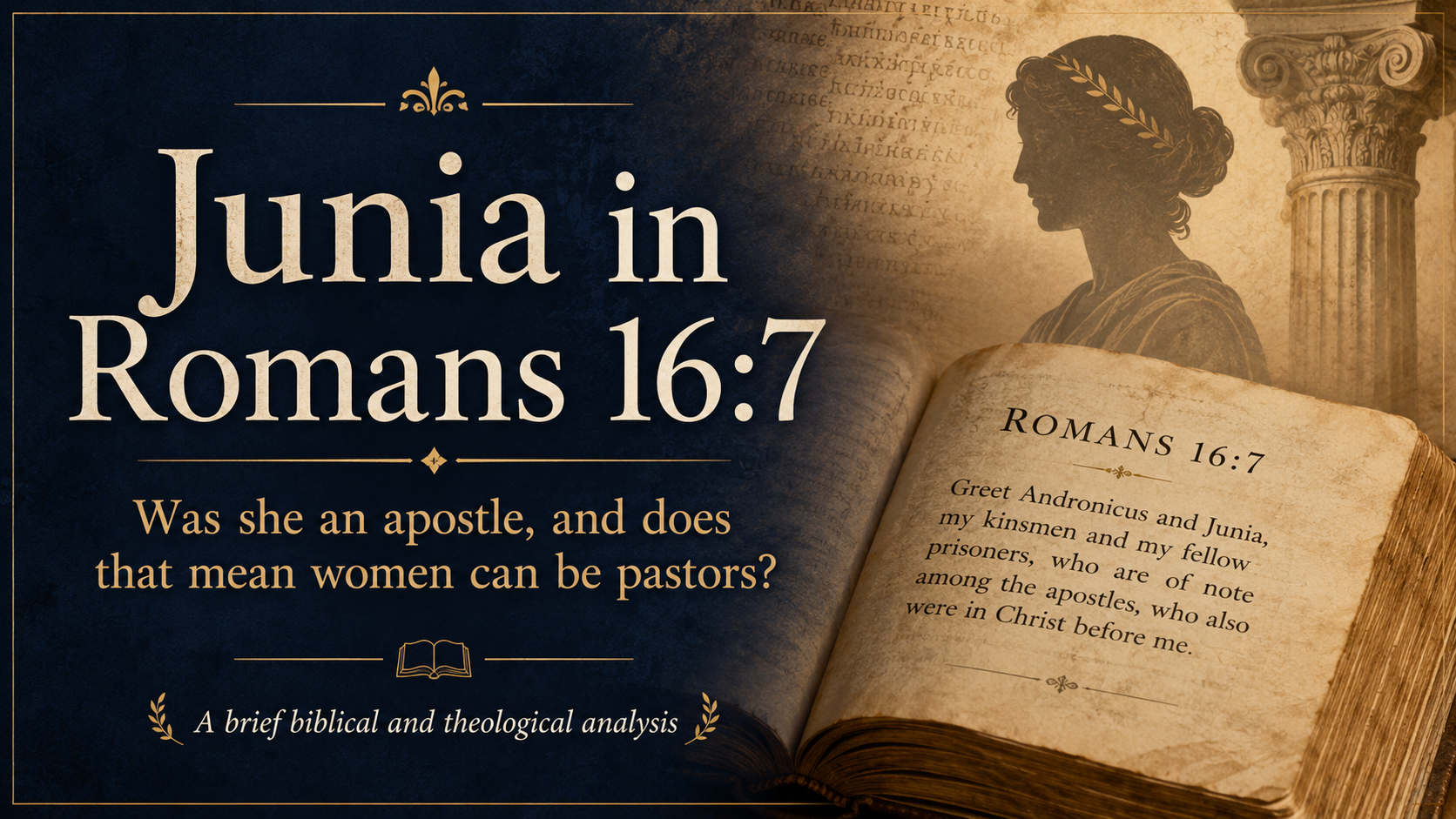
Romans 16:7 is often cited as the knockout text proving that women may serve as pastors. Paul writes, “Greet Andronicus and Junia, my kinsmen and my fellow prisoners. They are well known among the apostles, and they were in Christ before me.” The argument usually goes like this: Junia was a woman. Junia was an apostle. Therefore, women may be pastors. But that conclusion far outruns the text.
Let us grant, for the sake of argument, that Junia was a woman. Let us also grant the stronger translation, that she was “notable among the apostles,” rather than merely “well known to the apostles.” Even when we grant these, Romans 16:7 simply does not say that Junia was a pastor, elder, overseer, or one called into the public preaching office of the church. And that matters.
The Greek word translated “apostle” is ἀπόστολος (apostolos). It means one who is sent. In the New Testament, the word is not always used in the narrow technical sense of the Twelve or Paul, who were directly called by Christ as foundational witnesses of His resurrection. Oftentimes the word ἀπόστολος is used more broadly for a messenger, envoy, delegate, or missionary representative of the churches.
For example, in 2 Corinthians 8:23, Paul speaks of certain brothers as ἀπόστολοι ἐκκλησιῶν, “apostles of the churches,” or “messengers of the churches.” These men were sent by congregations. They were emissaries. They were not apostles in the same sense as Peter, John, or Paul. Likewise, in Philippians 2:25, Paul calls Epaphroditus ὑμῶν δὲ ἀπόστολον, “your apostle,” or “your messenger.” Again, Epaphroditus was sent by the Philippian church. He was not one of the Twelve. He was not Paul. He was a delegated messenger.
So when we come to Romans 16:7 and see the phrase ἐπίσημοι ἐν τοῖς ἀποστόλοις, “notable among the apostles,” we still have to ask a very basic question: apostle in what sense? Was Junia being identified as one of the foundational apostles of Christ, equal to the Twelve and Paul? The text does not say that nor does it permit that. Was Junia, then associated with a broader group of missionary workers, messengers, and sent ones known in the early church? That is the only other valid option available to us and that is a far cry from saying Junia was a pastor.
That is the category error in the modern argument. It moves from “Junia was prominent in apostolic Christian service” to “Junia held the pastoral office.” But Romans 16:7 never says that. Paul honors many women in Romans 16. Phoebe is called a servant of the church. Priscilla is a fellow worker. Mary worked hard. Tryphaena, Tryphosa, and Persis labored in the Lord. Junia suffered for Christ and was known among, or to, the apostles. These women were faithful, courageous, useful, and honored servants of Christ. Amen. But none of that is the same thing as saying they were ordained pastors.
The New Testament does not confuse Christian service with the pastoral office. All Christians serve. All Christians confess Christ. All Christians bear witness. Many Christians teach in proper settings. Some are sent as messengers. Some support the mission. Some suffer for the Gospel. But the public preaching office is treated as a distinct office.
When Paul gives the qualifications for the overseer in 1 Timothy 3 and Titus 1, he does not point us to Romans 16. He speaks of an ἐπίσκοπος, an overseer, who is to be μιᾶς γυναικὸς ἄνδρα, “the husband of one wife.” In 1 Timothy 2, Paul says, διδάσκειν δὲ γυναικὶ οὐκ ἐπιτρέπω, “I do not permit a woman to teach,” and then adds, οὐδὲ αὐθεντεῖν ἀνδρός, “or to exercise authority over a man.” Paul grounds this not in local culture, not in Roman patriarchy, not in Ephesian weirdness, but in creation: Ἀδὰμ γὰρ πρῶτος ἐπλάσθη, εἶτα Εὕα, “For Adam was formed first, then Eve.” That is the sedes doctrinae.
Clear texts govern unclear texts. Romans 16:7 is not the sedes doctrinae for the pastoral office. It is a greeting. A beautiful greeting. An important greeting. A text that shows us how highly Paul valued faithful women who labored and suffered for the Gospel. But it does not establish women’s ordination.
So the real question is not, “Was Junia important?” Of course she was. The question is not, “Did Junia serve Christ?” Of course she did. The question is not, “Can women be brave, faithful, doctrinally sound, sacrificial, and useful in the work of the Gospel?” Of course they can. The question is whether Romans 16:7 overturns Paul’s explicit teaching regarding the public teaching office of the church. And the answer is a resounding no.
Junia may have been notable among the ἀπόστολοι. But ἀπόστολος does not automatically mean pastor. And Romans 16:7 does not authorize what 1 Timothy 2 and 3 forbid. That is not an insult to Junia. It is simply letting Scripture speak with precision.