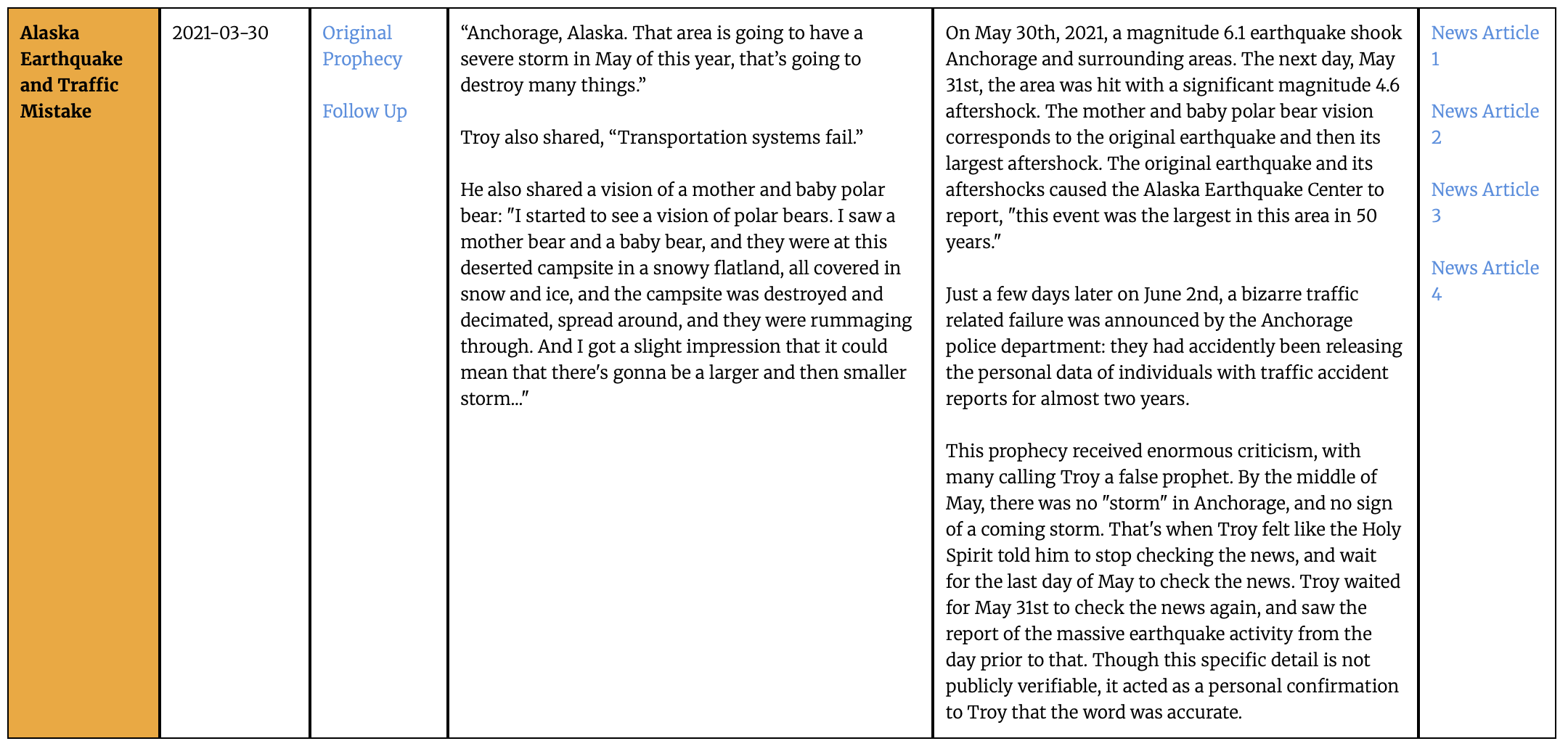
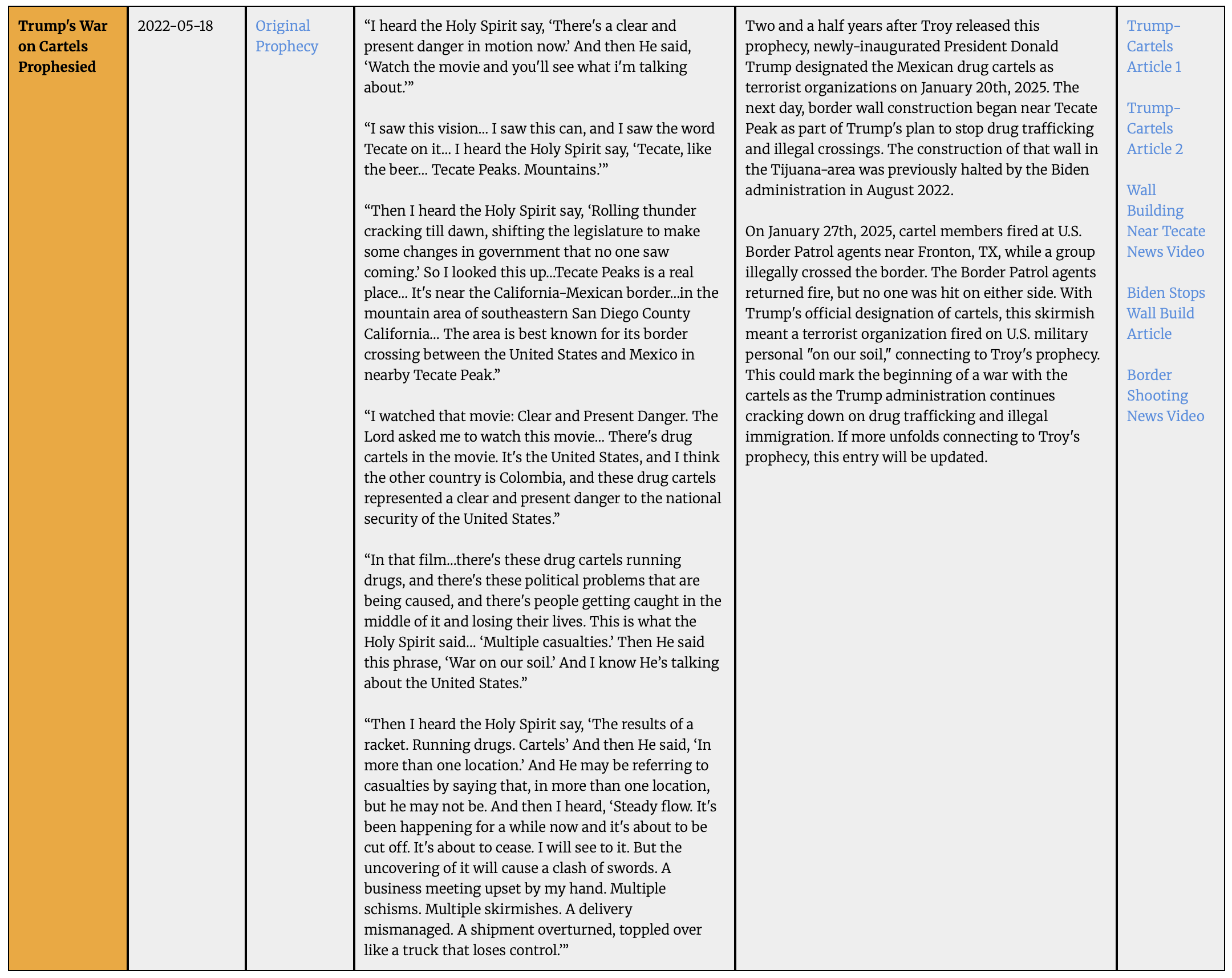
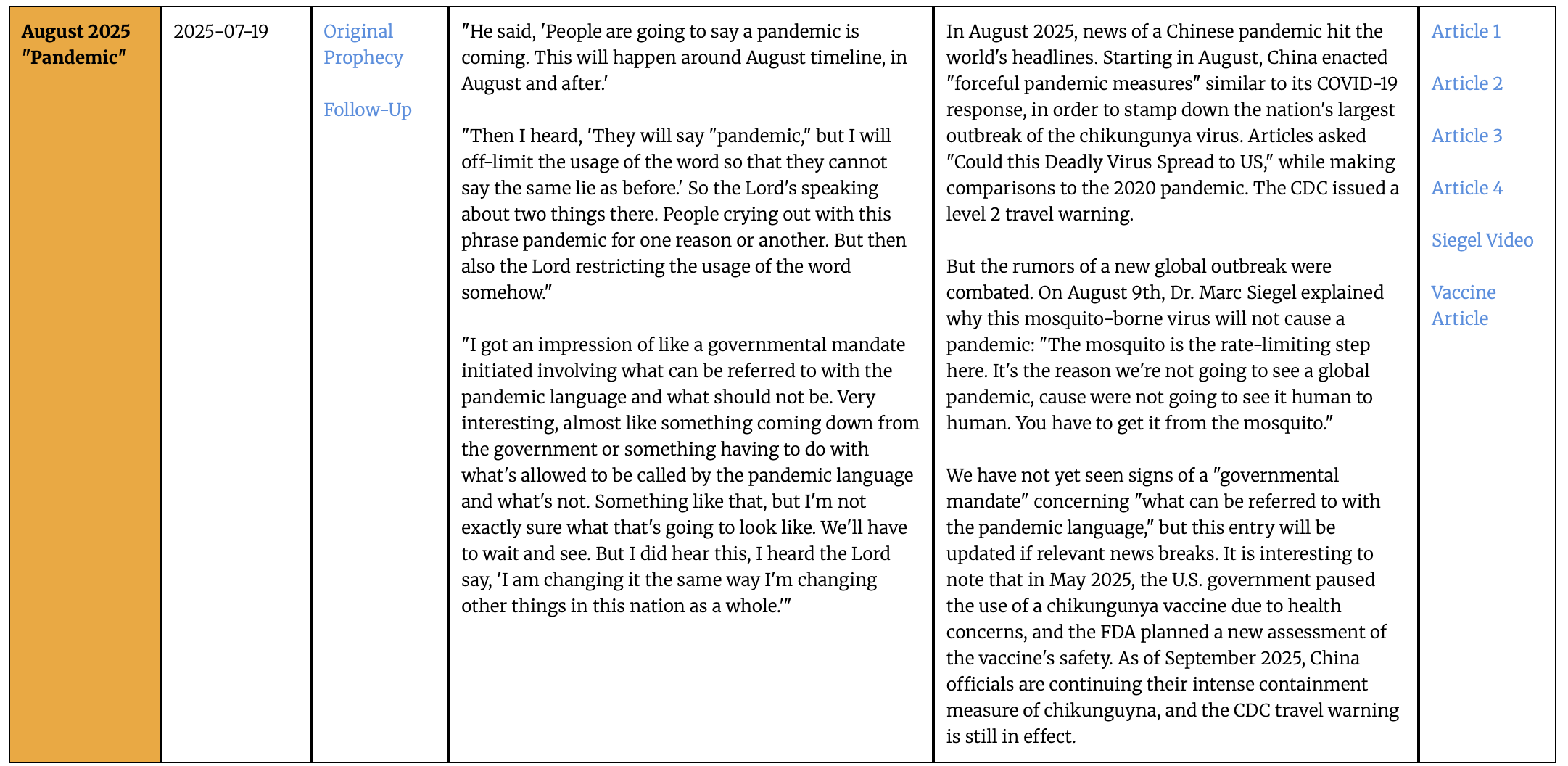
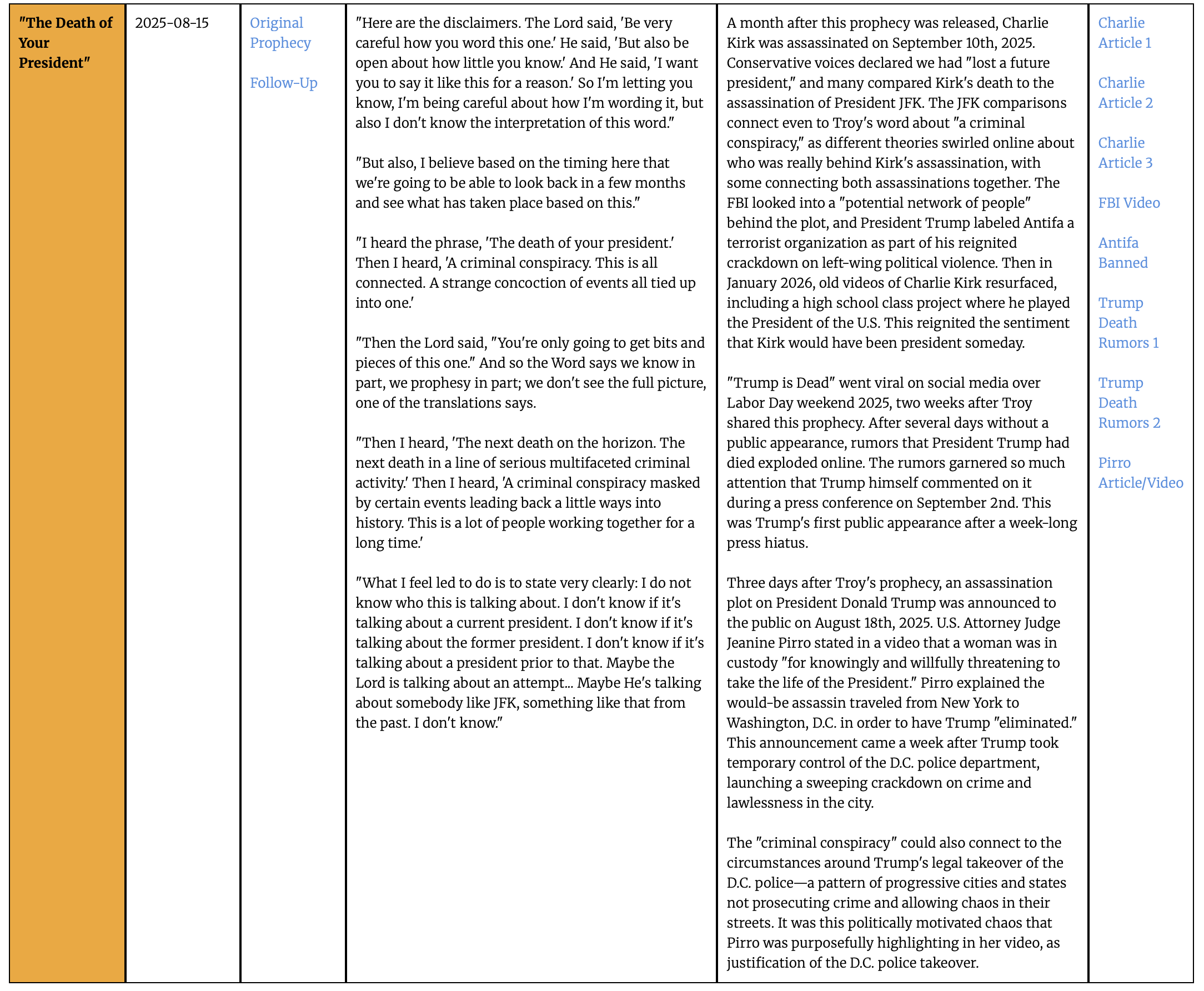
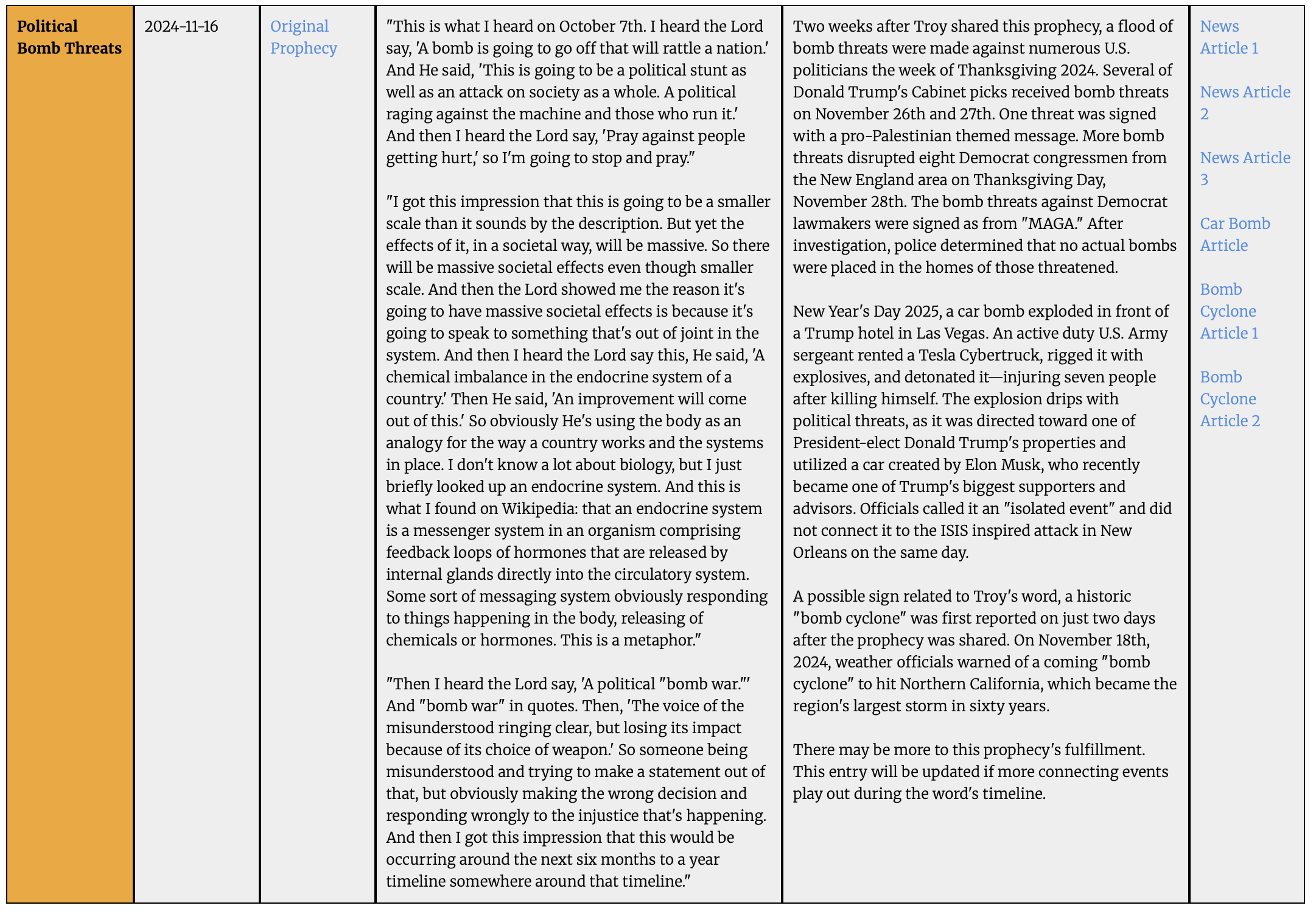
Troy says he received this word on October 7, 2024, and publicly shared it on November 16, 2024.
He predicted:
“A bomb is going to go off that will rattle a nation.”
He added:
“The effects of it, in a societal way, will be massive.”
Again, the words are understandable.
A bomb would explode.
The explosion would rattle a nation.
Its social effects would be massive.
The archive offered several possible fulfillments.
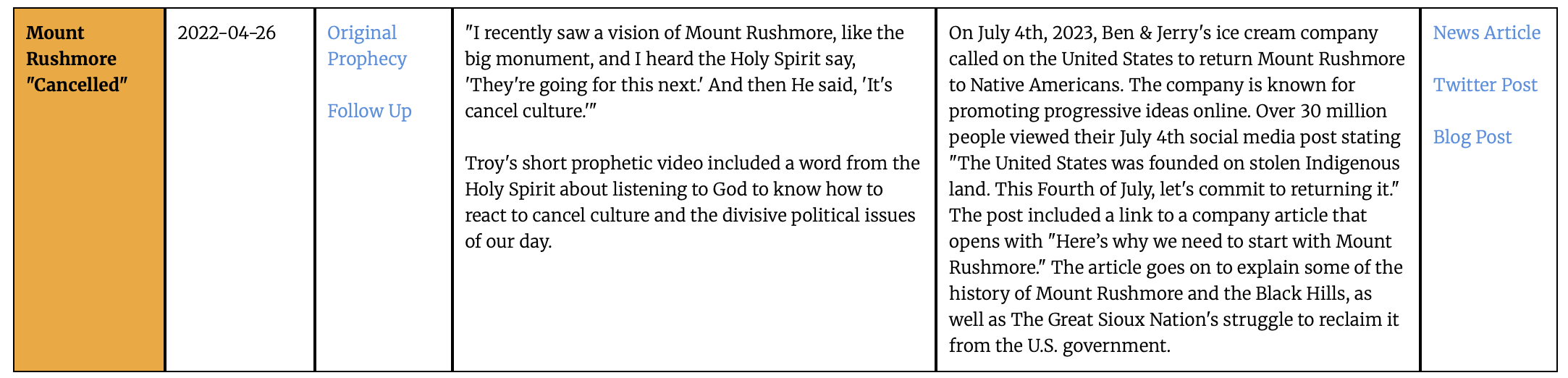
One involved bomb threats in which no bombs were found.
But a bomb threat is not a bomb going off.
Another involved a Tesla explosion that authorities described as an isolated event.
But an isolated vehicle explosion does not fulfill the prediction of an event producing massive societal consequences.
Another proposed fulfillment involved a weather system described as a “bomb cyclone.”
This is nothing more than a pun.
A bomb cyclone is a meteorological term. No explosive device detonates. There is no political bombing. There is no terrorist attack. The presence of the word “bomb” does not transform a weather report into the fulfillment of a prophecy that a bomb would go off.
Once again, the archive stated that there “may be more” and that the entry could be updated as further events unfolded.
In other words, the archive does not know what fulfilled the prophecy.
It is still looking.
Yet the prophecy is already listed as fulfilled.
This is backwards.
You do not declare a prophecy fulfilled and then continue searching for its fulfillment.
How the Troy’s “Fulfilled Prophecy Archive” Manufactures Fulfillments
The problems in these entries are not random.
A clear method emerges.
The archive begins with the assumption that Troy heard from God. It then interprets every prophecy in a way that preserves that assumption.
When the prediction does not match the event, the meaning of the prediction changes.
When the date does not match, the timeline moves.
When the central event does not occur, a threat or rumor becomes the fulfillment.
When no single event matches the prophecy, several unrelated events are gathered together.
When the alleged fulfillment happened before the prophecy, later publicity becomes the fulfillment.
When a prophecy remains incomplete, the archive declares it fulfilled and promises future updates.
The archive does not test Troy’s claims.
It protects them.
The Central Words Are Replaced
“The death of your president” becomes the death of Charlie Kirk, a rumor about President Trump, a threat against Trump, or a comparison to John F. Kennedy.
“Multiple casualties” becomes an incident in which nobody was hit.
“War on our soil” becomes an exchange of gunfire.
“An explosion” becomes a prevented explosion.
“A bomb” becomes a bomb threat or a meteorological expression.
The emotional force of Troy’s original language is retained while the actual meaning is replaced.
This allows the prophecy to sound dramatic when Troy gives it and become elastic when it is tested.
That is very convenient.
But it is not prophecy.
Several Unrelated Events Are Combined
Again and again, the archive takes individual details from unrelated stories and combines them.
One story supplies the location.
Another supplies a key word.
Another supplies the political theme.
Another supplies the time of year.
Another supplies the name of a public figure.
No single event fulfills the whole prophecy.
But when all the stories are placed beside each other, the collection creates the impression that Troy said something remarkable.
He did not.
A prophecy containing five details is not fulfilled because five unrelated events each contain one of those details.
If I predict that a red truck will crash into a grocery store in Minnesota on Christmas Eve and injure twelve people, that prophecy is not fulfilled because a blue car crashed in Minnesota, a truck crashed in Iowa, a grocery store caught fire in Texas, and twelve people were injured in Florida.
The predicted event must occur.
Collecting disconnected similarities does not make it so.
Literal and Symbolic Language Are Switched at Will
The archive moves between literal and symbolic meanings whenever necessary.
When a literal prediction fails, it becomes symbolic.
Death becomes a rumor of death.
War becomes tension.
A president becomes someone who might someday seek the presidency.
An explosion becomes a prevented explosion.
But when a symbolic expression appears in a news report, the archive treats it literally.
A “bomb cyclone” becomes important because Troy used the word “bomb.”
This allows the archive to interpret Troy’s words in opposite directions depending upon what later events require.
Literal when convenient.
Symbolic when necessary.
And always fulfilled.
Timelines Are Moved
Dates and timeframes are essential when testing predictive claims.
Without them, an archive can wait indefinitely for something vaguely similar to happen.
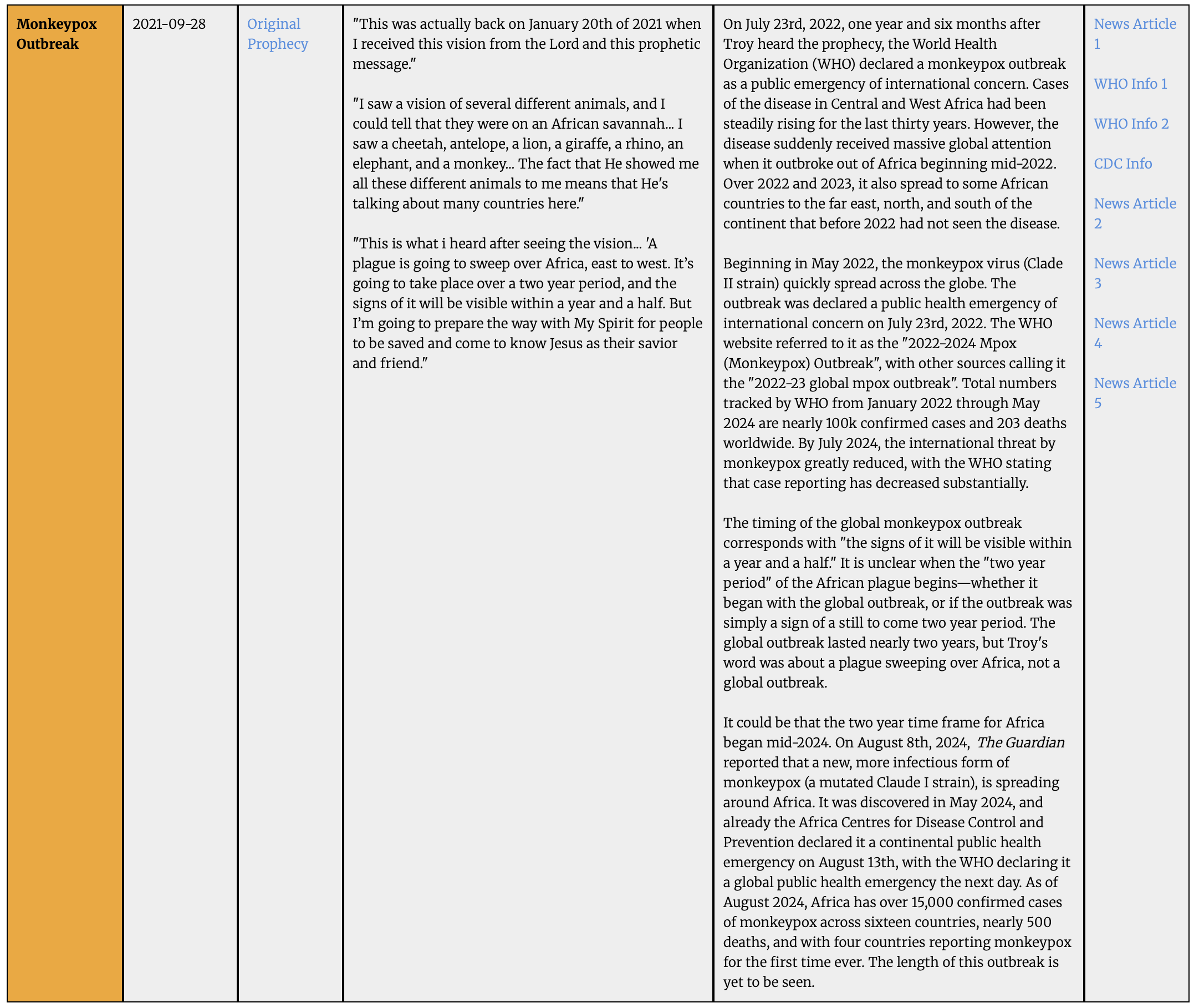
Troy’s African plague was supposed to unfold over two years. When the proposed event did not match the prophecy, the archive suggested that the two year period may have begun several years later.
Events predicted around one season can be connected to developments months afterward.
Unresolved prophecies remain open indefinitely.
Private dates, which outsiders cannot independently verify, are sometimes treated as the beginning of the prophetic clock.
A deadline that can be moved is not a deadline.
And a prophecy that can remain open forever can never fail.
Events That Happened First Are Called Fulfillments
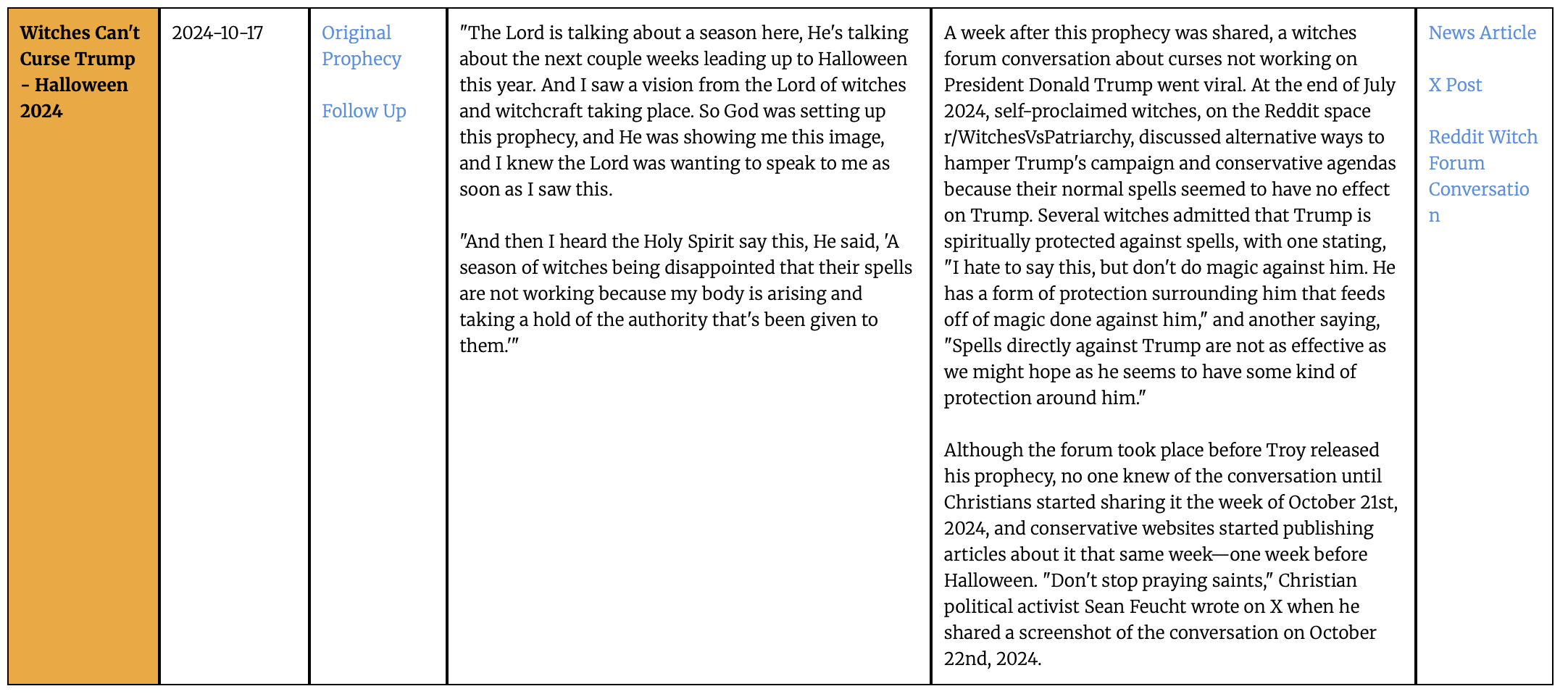
The witchcraft discussion happened before Troy published the prophecy.
The Sesame Street article appeared before the alleged prophetic word was released.
The archive attempts to solve this problem by pointing to later publicity.
But publicity is not the event.
A prophecy cannot predict something that has already happened unless the prophecy specifically predicts that the prior event will later be discovered or publicized.
Troy did not say, “An old conversation among witches will soon be discovered and circulated by Christians.”
He predicted the disappointment of witches leading into Halloween.
The disappointment had already occurred.
That is not foreknowledge.
That is afterknowledge.
Opposite Outcomes Both Prove the Prophecy
This may be the most serious problem of all.
If an explosion occurs, the prophecy is fulfilled.
If authorities stop the explosion, the prophecy is fulfilled.
If a bomb explodes, the prophecy is fulfilled.
If someone merely threatens to use a bomb, the prophecy is fulfilled.
If no bomb exists but a weather system is called a bomb cyclone, the prophecy is fulfilled.
If a president dies, the prophecy is fulfilled.
If a president does not die but rumors circulate that he died, the prophecy is fulfilled.
If no president dies but someone who might hypothetically have run for president dies, the prophecy is fulfilled.
Do you see the problem?
There is no possible outcome that requires the archive to admit that Troy was wrong.
That means the prophecies are not being tested.
They have been insulated from testing.
Selective Reporting Cannot Establish Accuracy
An archive of alleged successes cannot prove prophetic accuracy unless it also includes the failures.
How many prophetic words has Troy given?
How many contained specific, testable claims?
How many expired without fulfillment?
How many remain unresolved?
How many were reinterpreted after the fact?
How many depended upon symbolic meanings not stated in the original prophecy?
How many were matched to events that occurred before the prophecy?
How many apparent fulfillments would be expected by chance because of the sheer number and vagueness of Troy’s predictions?
The archive does not tell us.
Instead, it presents a selected group of alleged successes and declares that they prove Troy’s consistent accuracy.
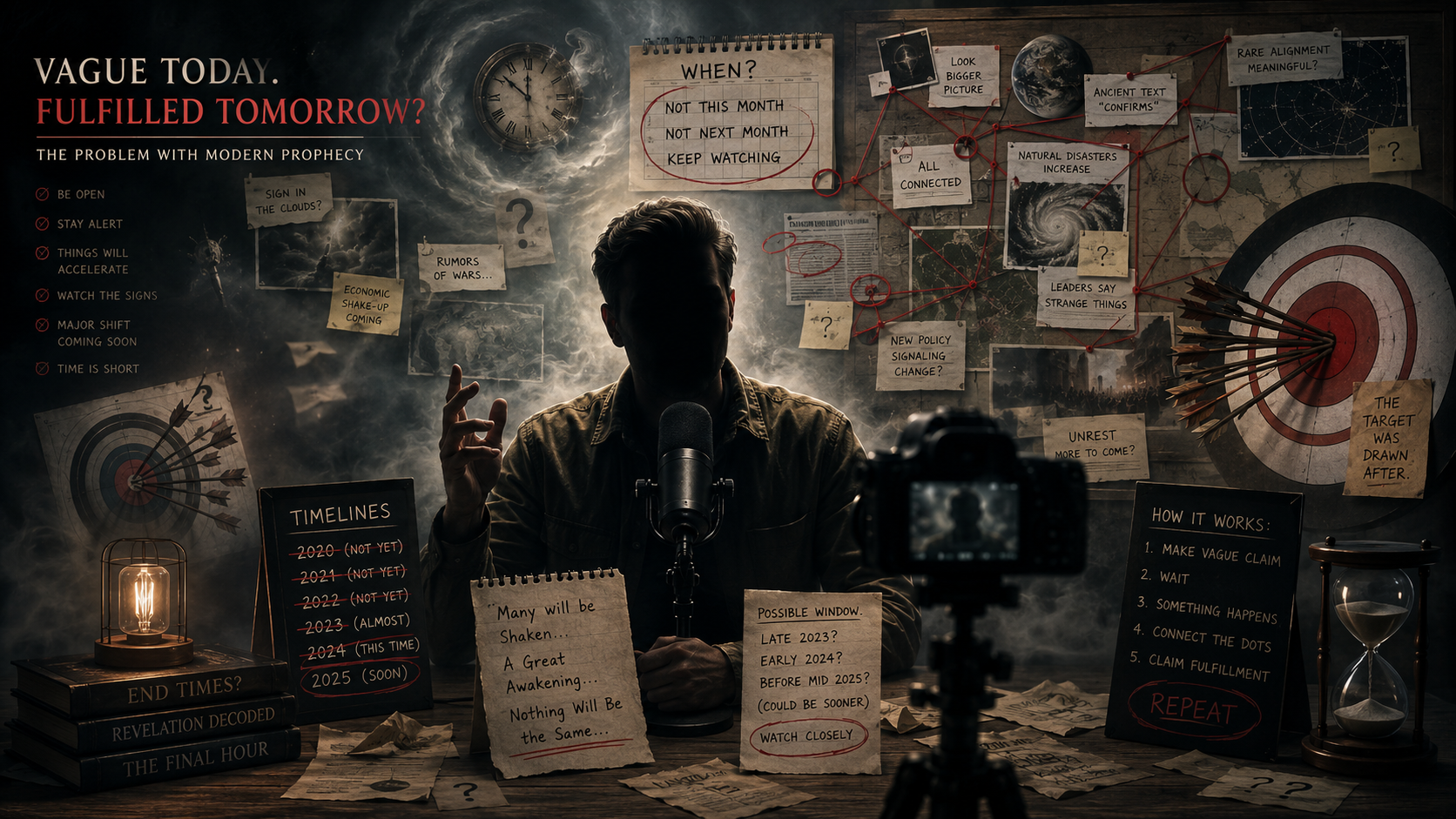
Imagine an archer who fires hundreds of arrows into the side of a barn.
Afterward, he walks over to the barn and paints a bullseye around every cluster of arrows.
Then he photographs the targets and creates a website celebrating his remarkable skill.
Would that prove he was an expert marksman?
Of course not.
He did not hit the targets.
He painted the targets around the places where his arrows happened to land.
That is what Troy Black’s archive does.
It fires vague prophetic words into the future and then paints circles around later events.
“We Prophesy in Part” Does Not Mean Prophecy Can Be False
One of the common defenses raised for failed modern prophecy is Paul’s statement in 1 Corinthians 13:9:
“For we know in part and we prophesy in part.”
This passage does not teach that prophecy from God may contain false information.
Paul says that knowledge is partial.
He does not say that it is erroneous.
A prophet may receive limited information. But whatever God actually reveals will be true.
Suppose God reveals that a king will die.
The prophet may not know when the king will die.
He may not know how the king will die.
He may not know who will succeed the king.
That would be partial revelation.
But if the king does not die, the prophet cannot point to a rumor of the king’s death and declare victory.
He cannot point to a threat against the king.
He cannot point to the death of someone who might someday have become king.
He cannot say that the king experienced the symbolic death of his reputation.
Partial revelation is not false revelation.
Mystery is not error.
The fact that a prophecy contains limited details does not give the prophet permission to change the details God allegedly supplied.
God Does Not Grade Prophets on a Curve
The biblical standard is not “close enough.”
The issue is not whether Troy occasionally says something that sounds spiritual, encouraging, politically agreeable, or statistically likely.
The issue is whether God spoke.
Troy does not merely say, “I have a feeling.”
He does not say, “Here is my best guess.”
He does not say, “I am concerned that this may happen.”
He says that the Holy Spirit revealed these things to him.
Once God’s name is attached to the words, the matter becomes deadly serious.
Deuteronomy 18:21 and 22 says:
“And if you say in your heart, ‘How may we know the word that the LORD has not spoken?’ when a prophet speaks in the name of the LORD, if the word does not come to pass or come true, that is a word that the LORD has not spoken; the prophet has spoken it presumptuously.”
God does not establish a prophetic batting average.
He does not tell Israel to count vague verbal correspondences.
He does not permit prophets to replace the predicted person, location, event, or outcome after the prophecy fails.
He does not say that a prediction is fulfilled when the opposite occurred.
The word either comes to pass, or it does not.
Jeremiah gives the same warning:
“Do not listen to the words of the prophets who prophesy to you, filling you with vain hopes. They speak visions of their own minds, not from the mouth of the LORD.”
Jeremiah 23:16
The prophets condemned by Jeremiah were not all atheists standing outside Israel and mocking Yahweh.
They spoke religious words.
They offered hope.
They claimed divine authority.
They told people that God had spoken.
But their visions came from their own minds.
That is the danger confronting the Church whenever a man takes his own thoughts, dreams, impressions, anxieties, political expectations, or imaginative associations and places them into the mouth of God.
Troy Black’s Archive Is Evidence Against His Claims
Troy Black’s prophecy archive does not prove that he possesses a genuine prophetic gift.
It proves something else.
It proves that his prophetic claims are being preserved through vague wording, moved timelines, symbolic reinterpretation, selective reporting, retroactive pattern matching, and standards that make failure impossible.
The archive contains prophecies whose essential details did not occur.
It contains events that happened before the prophecy was published.
It substitutes rumors for deaths.
It substitutes threats for events.
It substitutes prevented explosions for explosions.
It substitutes weather terminology for bombs.
It divides single prophecies among several unrelated news stories.
It lists unresolved prophecies as fulfilled while waiting for more information.
It converts broad religious observations into predictions after later events have taken place.
This is not prophetic verification.
It is an elaborate exercise in confirmation bias.
The archive begins with the conviction that Troy Black is a prophet and then bends every event until it fits that conviction.
And because every outcome can be made to confirm the prophecy, no outcome can disprove it.
That should deeply concern every Christian who loves God’s Word.
False prophecy does not remain confined to the realm of harmless speculation. It teaches Christians to mistake human imagination for divine revelation. It burdens consciences with words God has not spoken. It distracts the Church from the written Scriptures. It trains people to search headlines for secret prophetic correspondences rather than hear the clear voice of Christ in His Word.
Worst of all, it places God’s name upon the words of a man.
Christ’s sheep do not need Troy Black’s vague predictions.
They already possess the prophetic and apostolic Scriptures.
They already have the sure prophetic Word.
They already know what the future holds.
Christ will preserve His Church.
The Gospel will be preached.
False prophets will arise.
The world will rage.
The dragon will make war against those who hold to the testimony of Jesus.
Christ will return.
The dead will rise.
The wicked will be judged.
And all who trust in Christ will inherit the resurrection and the life of the world to come.
These promises do not need moved deadlines, symbolic substitutions, rumors, puns, or teams of interpreters searching the internet for possible fulfillments.
God’s Word is truth.
Therefore, based upon the evidence presented in Troy Black’s own archive, there is no compelling reason to believe that he is operating with a genuine prophetic gift.
There is abundant reason to conclude that Troy is taking his own impressions, placing them into God’s mouth, and then retroactively fitting later events to them.
Scripture has a word for that.
Presumption.
—
Additional Resources:
Below is the audio to a sermon preached by Pastor Rosebrough on July 26th, 2026 about false prophets and how God does not want us to listen to them. This absolutely applies to Troy Black and his followers.