The Salem Witch Trials: A Historical Warning for the Age of Conspiracy Theories
/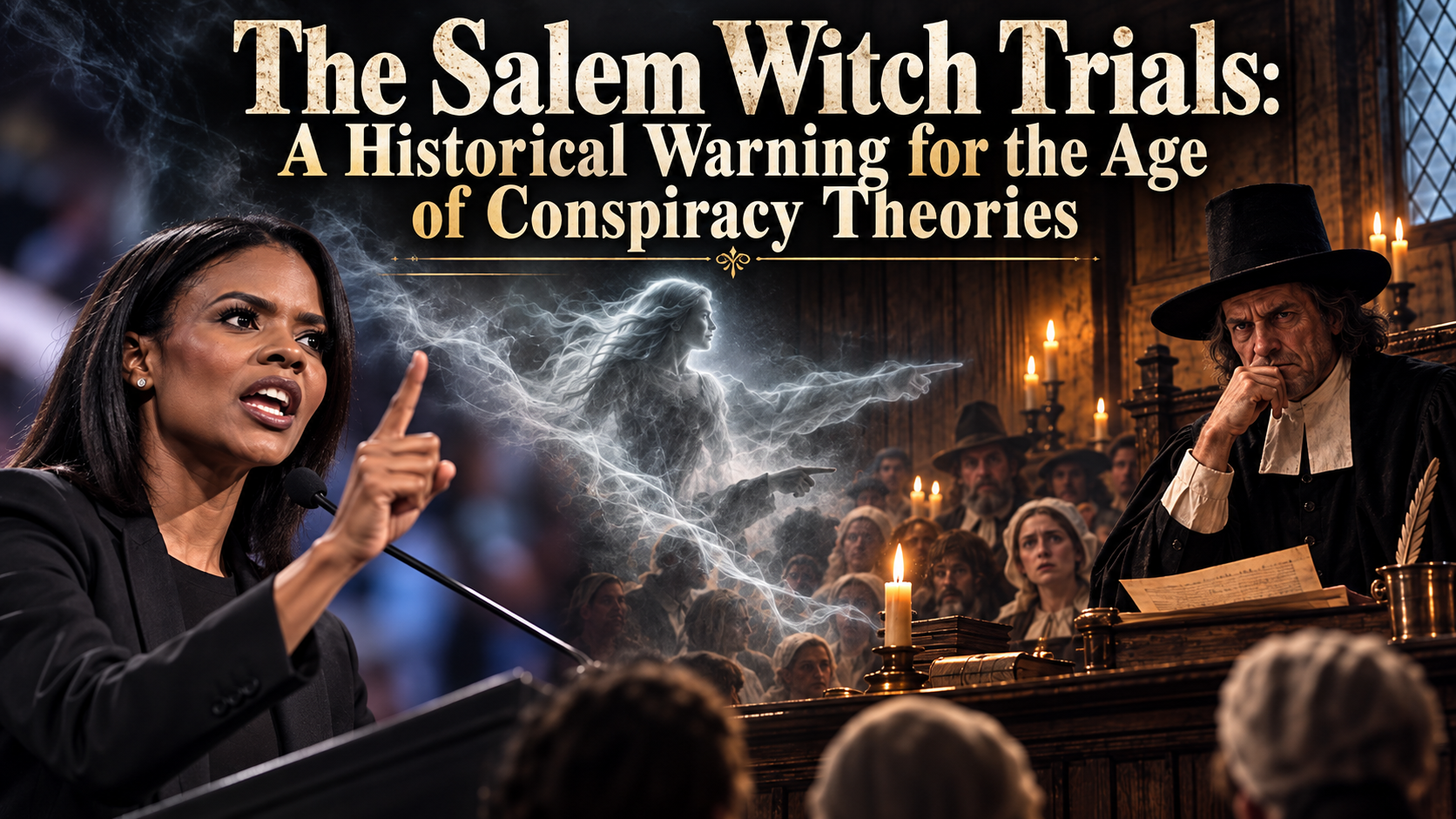
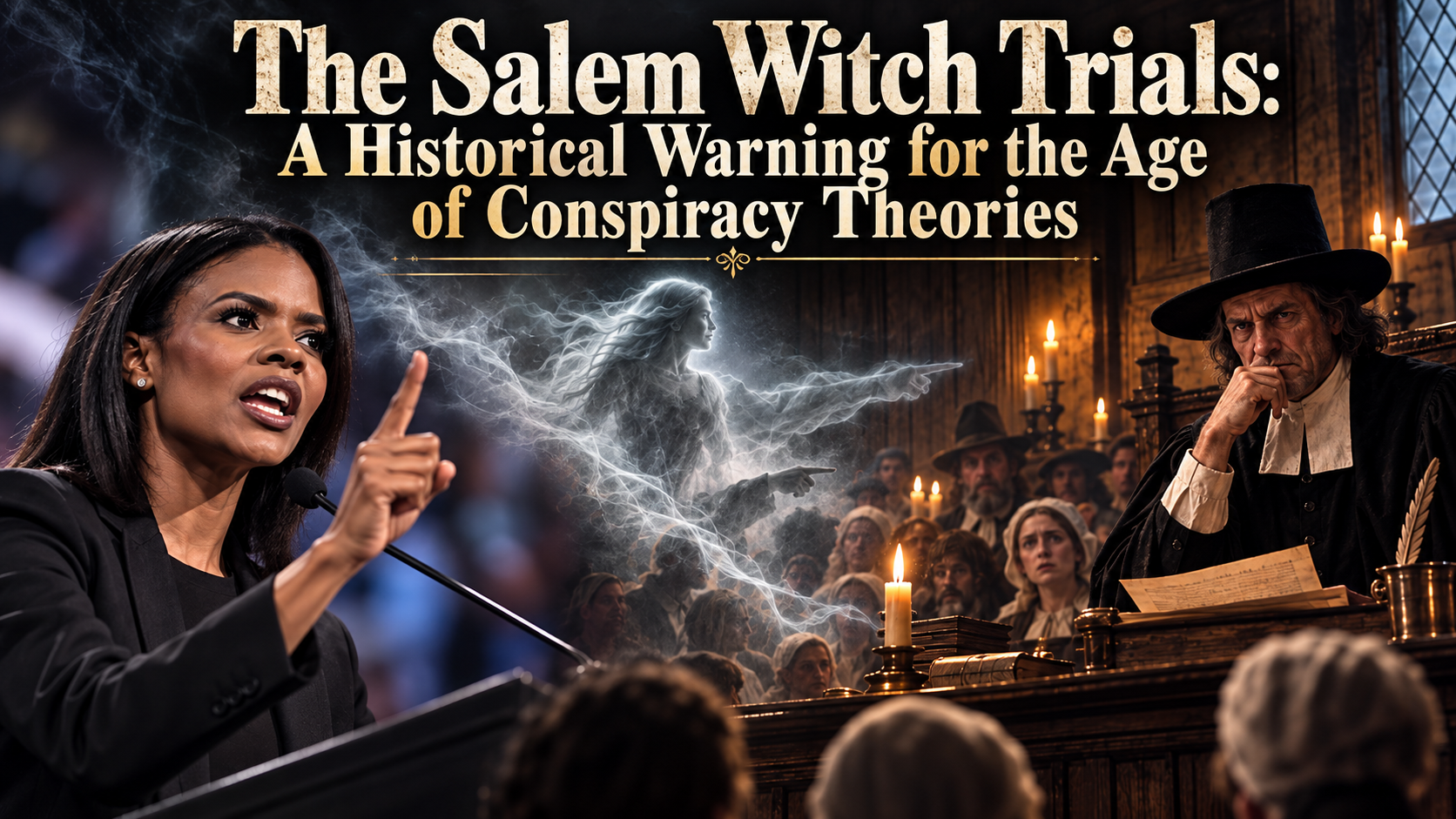
The Salem Witch Trials of 1692 remain one of the most notorious examples of mass hysteria and the miscarriage of justice in American history. What began as accusations of witchcraft in a small Puritan community in colonial Massachusetts developed into a crisis that resulted in the execution of 20 innocent people, 19 by hanging and one by being pressed to death beneath heavy stones. At least five others died in prison, and more than 200 people were accused. The tragedy revealed five disastrous failures: a climate of fear and distrust, the elevation of subjective experiences over verifiable evidence, the abandonment of the presumption of innocence, the contagious spread of accusations, and the failure of authorities to restrain the hysteria. These failures have striking parallels with the manner in which contemporary conspiracy theories spread, including Candace Owens's public campaign of suspicion surrounding the assassination of Charlie Kirk.
The first major breakdown was a climate of fear and distrust. Salem Village was already experiencing considerable political, religious, and social turmoil. Disputes over property, conflicts between families, warfare on the colonial frontier, and uncertainty surrounding the legitimacy of the colonial government created widespread anxiety. Trust in established institutions had deteriorated, and ordinary misfortunes increasingly became evidence of sinister forces operating behind the scenes. There is a recognizable parallel in contemporary America, where public confidence in government, journalism, and other institutions has suffered considerably, particularly in the aftermath of the COVID-19 pandemic. Some of that distrust has legitimate foundations. Governments and institutions have made serious mistakes and sometimes acted dishonestly. Nevertheless, legitimate distrust does not establish the truth of every allegation leveled against those institutions. In her coverage of Charlie Kirk's assassination, Candace Owens has repeatedly encouraged suspicion toward official accounts and people associated with Turning Point USA. The danger arises when institutional distrust becomes so comprehensive that virtually any official explanation is presumed deceptive simply because it comes from an institution.
The second breakdown was the replacement of verifiable evidence with subjective experiences and extraordinary claims. In early 1692, several young girls began exhibiting strange behaviors that were attributed to witchcraft. Accusations followed, and the courts eventually accepted what became known as spectral evidence, testimony alleging that the invisible spirit of an accused person had appeared and tormented someone. Such claims were extraordinarily difficult, if not impossible, to verify independently. This has a particularly disturbing parallel with Candace Owens's claim that Charlie Kirk appeared to her in a dream and told her that he had been betrayed. Owens described believing that Kirk's soul was in purgatory and tied her dream to suspicions involving Andrew Kolvet, a major figure associated with Turning Point USA. Strictly speaking, this was not identical to Salem's spectral evidence, because Owens claimed that the deceased victim appeared rather than the spirit of the accused. Nevertheless, the fundamental evidentiary problem is remarkably similar. A private supernatural experience, inaccessible to independent examination, is being used to lend credibility to allegations involving identifiable living people. A dream may be sincerely experienced, but sincerity does not transform it into credible evidence of someone else's wrongdoing.
The third breakdown was the abandonment of the presumption of innocence. During the Salem proceedings, accusations frequently operated as presumptions of guilt. Denying an accusation could be interpreted as deception, protesting one's innocence could be treated as defiance, and attempts to defend oneself could actually intensify suspicion. Confessions and accusations against others, meanwhile, could improve an accused person's prospects of survival. The resulting system made it extraordinarily difficult for innocent people to clear their names. A similar logical problem happens when conspiracy theories become effectively impossible to falsify. If an individual denies involvement in a suspected conspiracy, the denial can be dismissed as a coverup. If the person declines to respond, such silence can be interpreted as suspicious. If contrary evidence emerges, that evidence can be characterized as manufactured or part of a combined effort to conceal the truth. Owens's treatment of Andrew Kolvet's failure to respond to her message about the dream illustrates this danger. Silence is not proof of guilt, and the absence of a satisfactory response does not establish the truth of an accusation. When every conceivable response can be incorporated into a theory as confirmation, the theory has ceased to function as a genuinely testable explanation.
The fourth breakdown was the spread of social contagion and the weaponization of accusations. As the Salem panic intensified, accusations multiplied and spread throughout surrounding communities. Existing disagreements and personal diagreements could now be interpreted through the lens of witchcraft. Even respected church members, including Rebecca Nurse and Martha Corey, found themselves accused. Rumors spread rapidly, and those who questioned the prevailing narrative risked becoming objects of suspicion themselves. This pattern resembles what occurs when conspiracy theories spread through modern digital media. Audiences become emotionally invested in a particular explanation, new allegations continually confirm existing suspicions, and individuals who dispute the narrative risk being portrayed as compromised, deceptive, or complicit. Owens's public allegations concerning individuals associated with Turning Point USA illustrate the reputational stakes involved. Her large audience does not make her claims true, but it can magnify their consequences. What took weeks to spread through colonial Massachusetts can now circulate among millions of people within hours.
The fifth and most consequential breakdown was the failure of civil and religious authorities to restrain the hysteria. Rather than consistently insisting upon credible evidence, the magistrates of Salem permitted highly questionable testimony to influence judicial proceedings. In May 1692, Governor William Phips established the special Court of Oyer and Terminer, which tried accused witches and admitted spectral evidence. Not all religious leaders approved of these practices. Cotton Mather cautioned against overreliance upon spectral evidence, while Increase Mather argued that it would be better for ten suspected witches to escape punishment than for one innocent person to be condemned. Their objections exposed the central injustice: the protection of innocent people must take precedence over the desire to punish suspected enemies. Today, Candace Owens does not possess the judicial authority wielded by the Salem magistrates. Nevertheless, influential commentators possess considerable power to form public opinion and damage reputations. That influence carries a corresponding moral responsibility to distinguish documented facts from speculation and to resist presenting unsubstantiated suspicions as established conclusions.
By the autumn of 1692, the injustice unfolding in Salem was becoming more and more evident. Governor Phips dissolved the Court of Oyer and Terminer in October, and the replacement court rejected spectral evidence. Convictions declined dramatically, and by May 1693 the remaining prisoners had been released. But the damage was already done. Innocent people had been executed, families destroyed, reputations ruined, and an entire community had been compelled to face the consequences of its credulity. The Salem Witch Trials did not end because everyone suddenly abandoned belief in supernatural evil. They ended when the legal authorities stopped allowing claims about invisible supernatural activity to function as sufficient proof of guilt. That distinction is essential. The proper lesson of Salem is not that every suspicion is necessarily false or that institutions should never be questioned. Rather, it is that suspicion must never be permitted to substitute for evidence, regardless of how emotionally compelling or widely accepted a particular narrative becomes.
The similarities between Salem and today's conspiracy culture are especially concerning because conspiracy theories frequently develop systems of reasoning that protect their central claims from meaningful scrutiny. Coincidences become clues, unanswered questions become proof of concealment, denials become evidence of complicity, and lack of evidence becomes evidence of how successfully the conspiracy has been hidden. In such an environment, a person's reputation can be destroyed without credible proof of wrongdoing. Owens's alleged dream visitation from Charlie Kirk illustrates this danger with unusual clarity. The question is not whether God possesses the power to communicate through dreams. Scripture plainly records occasions when He has done so. The question is whether a modern individual's dream provides legitimate grounds for publicly implicating another person in betrayal or criminal wrongdoing. Scripture gives us no permission to suspend the requirements of truthfulness, credible testimony, and justice merely because someone claims supernatural confirmation of a suspicion.
For Christians, the Salem Witch Trials provide a sobering illustration of why the Eighth Commandment continues to be indispensable, especially during periods of social and political instability. Luther explains that we are forbidden to bear false witness against our neighbor and are obligated to defend his reputation rather than destroy it through unsubstantiated accusations. Deuteronomy 19:15 requires that there be adequate witnesses to establish wrongdoing, while Proverbs 18:17 warns that the first person to present a case may appear correct until the matter is examined. These biblical principles do not cease to apply when governments become untrustworthy, institutions act corruptly, or popular commentators claim to have exposed covert conspiracies. Indeed, those are precisely the circumstances in which the commandments are most urgently needed. Corruption must be exposed, wrongdoing must be investigated, and institutions that have forfeited people's trust must be held accountable. But the answer to genuine corruption is evidence, due process, and reform, not the abandonment of truthfulness and justice. The continuing warning of Salem is that when suspicion becomes evidence, accusation becomes conviction, and every denial becomes further proof of guilt, the pursuit of truth has been replaced by a witch hunt.
Bibliography
Baker, Emerson W. A Storm of Witchcraft: The Salem Trials and the American Experience. Oxford University Press, 2014.
Mather, Increase. Cases of Conscience Concerning Evil Spirits Personating Men. Boston, 1693. https://salem.lib.virginia.edu/speccol/mather/mather.html
Norton, Mary Beth. In the Devil's Snare: The Salem Witchcraft Crisis of 1692. Alfred A. Knopf, 2002.
Owens, Candace. “American Horror Story: Charlie Kirk's ‘Shining’ Disciples.” Candace, Episode 288, January 13, 2026. https://podscripts.co/podcasts/candace/american-horror-story-charlie-kirks-shining-disciples-candace-ep-288
Rosenthal, Bernard, general editor. Records of the Salem Witch Hunt. Cambridge University Press, 2009.
University of Virginia. Salem Witch Trials Documentary Archive and Transcription Project. Edited under the supervision of Benjamin C. Ray. https://salem.lib.virginia.edu/
Luther, Martin. The Large Catechism. 1529. Part I, The Eighth Commandment, paragraphs 254–286. The Book of Concord. https://bookofconcord.org/large-catechism/
The Holy Bible, English Standard Version. Crossway, 2016. Relevant passages: Exodus 20:16; Leviticus 19:16; Deuteronomy 19:15–21; Proverbs 18:13, 17; Proverbs 25:18; Matthew 18:15–16; 1 Timothy 5:19.