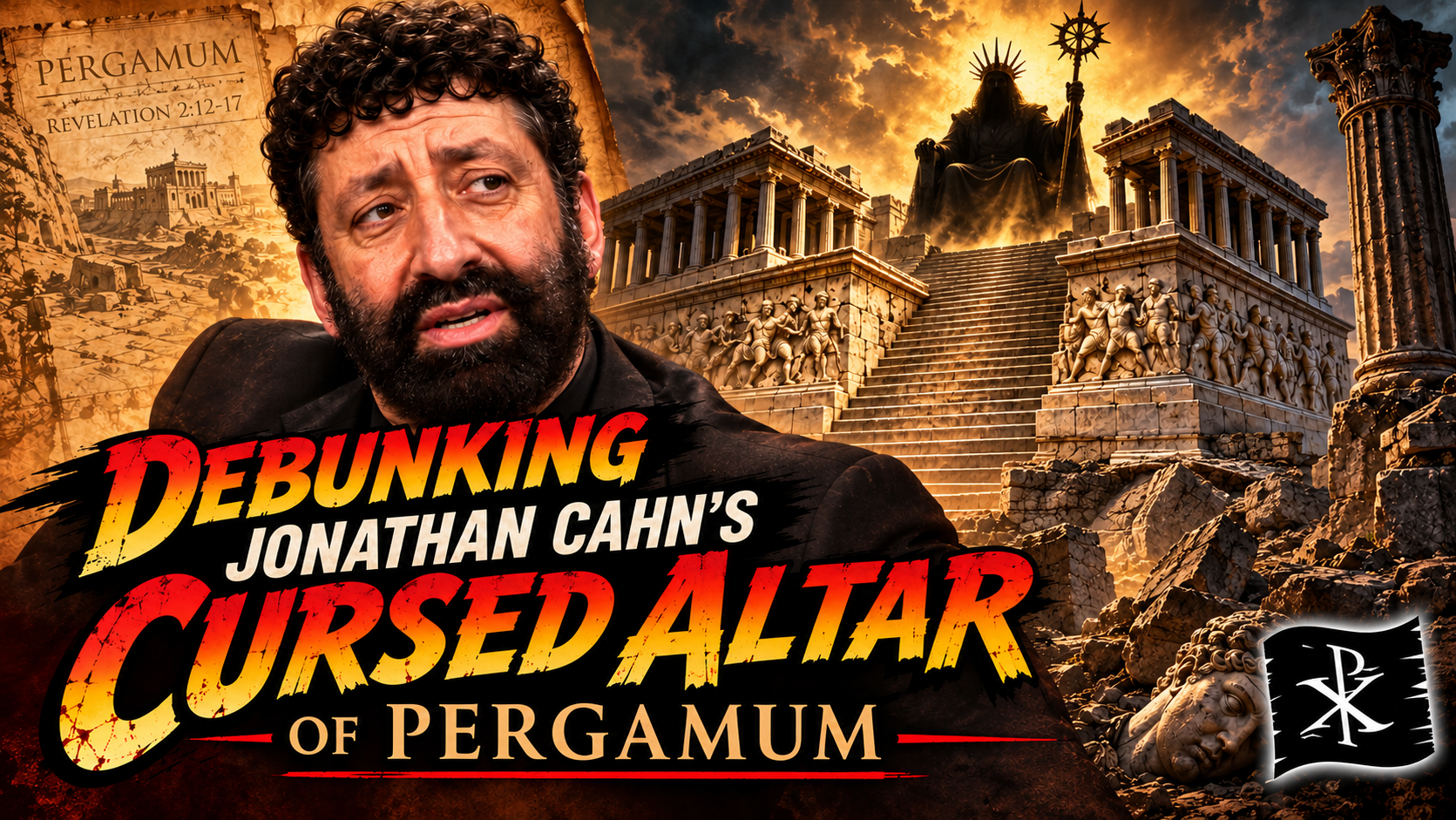
Sources and Bibliography for My Examination of Jonathan Cahn’s Pergamum Altar Claims
/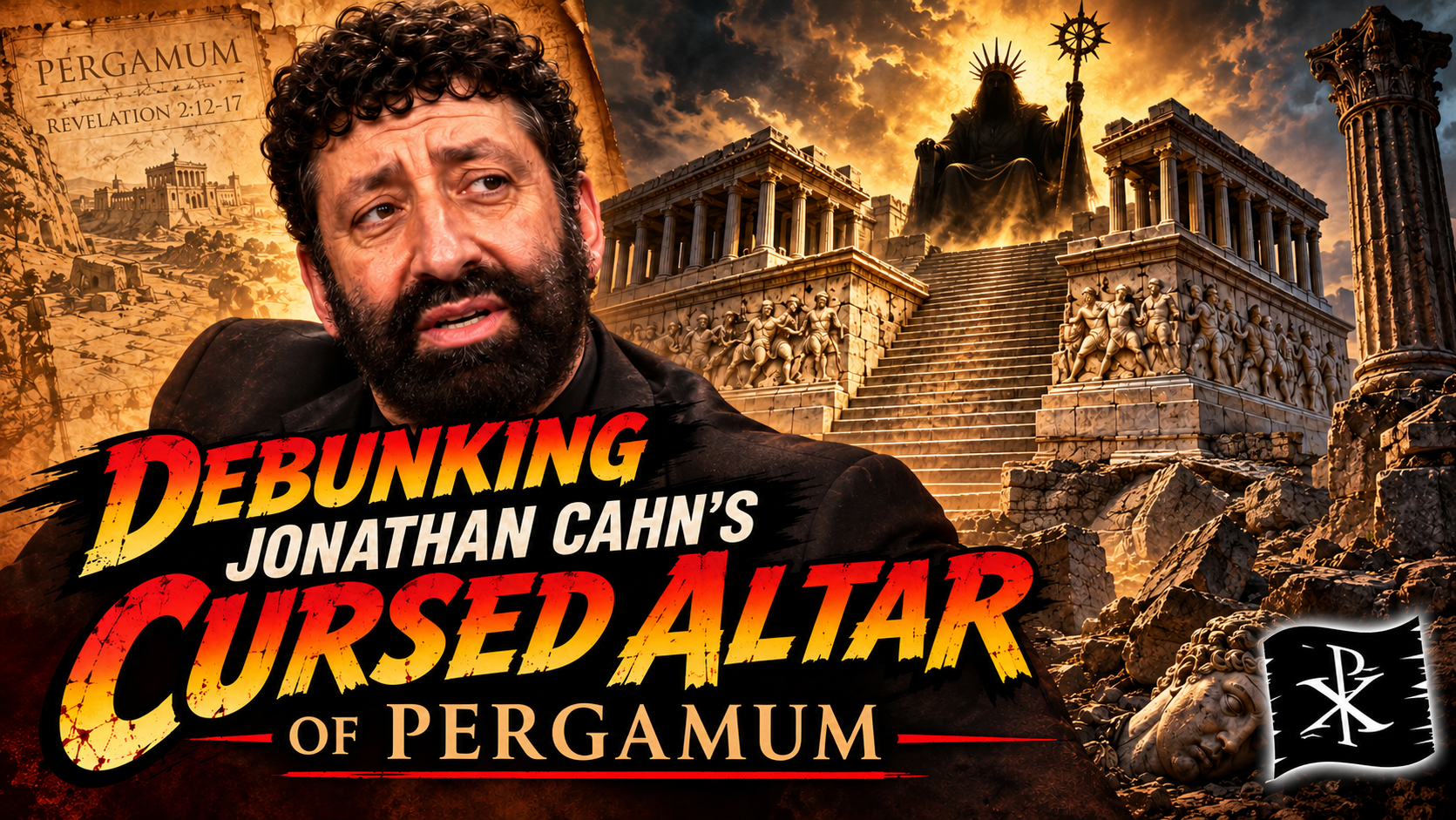
In my examination of Jonathan Cahn’s claims concerning the Pergamum Altar, I have attempted to follow ordinary standards of historical and theological research. That means checking chronology, consulting primary and institutional sources whenever possible, examining the history of interpretation, distinguishing correlation from causation, and testing theological claims against the biblical texts themselves.
I am making my Keynote available for download here.
I am also providing my sources below so that readers and viewers can check my work for themselves. I encourage you to do so.
My objection to Cahn’s narrative is not simply that I disagree with his conclusions. The larger problem is that several of his central historical claims cannot be reproduced from the documentary evidence, while some are directly contradicted by it. His theological claims concerning the supposed occult power of the Pergamum Altar likewise go considerably beyond anything taught in Scripture.
The Pergamum Altar and the Pergamon Museum
Staatliche Museen zu Berlin. “Profile of the Pergamonmuseum.”
This is the official website of the State Museums of Berlin, the institution responsible for the Pergamon Museum. Its history of the museum states that a smaller predecessor building already contained an initial reconstruction of the Pergamum Altar before the present museum was completed in 1930. (Staatliche Museen zu Berlin)
Pergamonmuseum official history
Staatliche Museen zu Berlin and Fraunhofer IGD. “The Pergamon Altar 3D.”
This institutional resource is particularly important. It states that the work of Richard Bohn and Otto Puchstein formed the basis for the first reconstruction of the altar in the predecessor museum, which existed from 1901 to 1909. It then explains that beginning in 1930 the western front was displayed in the more complete reconstruction familiar today. (3D Museum)
Official Pergamon Altar 3D project
Staatliche Museen zu Berlin. “Refurbishment.”
This official page explains the current restoration and modernization of the Pergamon Museum, including the restoration of the Altar Hall and the altar reconstruction. This is relevant to claims that the altar has mysteriously been “hidden.” The museum describes a conventional conservation and renovation project. (Staatliche Museen zu Berlin)
Pergamonmuseum refurbishment information
Weimarer Republik. “October 1930.”
This historical chronology records that the new Pergamon Museum opened on October 2, 1930. (Weimarer Republik)
This becomes particularly important when Cahn connects the museum opening with the Nazi electoral breakthrough. The Reichstag election in which the Nazis won 18.3 percent had already occurred on September 14, eighteen days earlier.
Hebcal. “Yom Kippur 1930.”
This confirms one detail of Cahn’s account that should be acknowledged. October 2, 1930 was indeed Yom Kippur, 10 Tishrei 5691. Yom Kippur began the previous evening. (Hebcal)
The coincidence is real. What does not follow from that coincidence is Cahn’s proposed supernatural causation.
Revelation 2:13 and “Satan’s Throne”
The Holy Bible, Revelation 2:12 to 17.
Revelation 2:13 says that the Christians at Pergamum dwelt “where Satan’s throne is” and again describes Pergamum as the place “where Satan dwells.”
The text itself does not identify the Great Altar of Pergamum as that throne.
A Greek and English presentation of the passage can be consulted here:
William Henry Simcox. The Revelation of St. John the Divine, Cambridge Bible for Schools and Colleges. 1890.
Simcox is exceptionally important because he discusses the altar interpretation shortly after the nineteenth century excavations. He explicitly introduces it as a suggestion arising “since recent excavations,” and he does not treat the identification as settled. He also considers other interpretations of Satan’s throne. (Bible Hub)
Richard Chenevix Trench. Commentary on the Epistles to the Seven Churches in Asia.
Trench discusses the difficulty of identifying what specifically made Pergamum “Satan’s throne” and regards the question as unresolved. His discussion predates the developed altar theory associated with the later excavations. (Christian Classics Ethereal Library)
William Milligan. The Book of Revelation, in The Expositor’s Bible.
Milligan associates Pergamum’s description with the city’s pervasive paganism and the worship of Aesculapius rather than making the Pergamum Altar itself the definitive referent. (Christian Classics Ethereal Library)
Victorinus of Pettau. Commentary on the Apocalypse.
Victorinus is particularly valuable because he is one of the earliest surviving Christian commentators on Revelation. His treatment gives us a window into early Christian interpretation of the Apocalypse. The surviving commentary does not present the nineteenth century identification of the Pergamum Altar as Satan’s throne. (New Advent)
Victorinus, Commentary on the Apocalypse
A second online edition is available through Christian Classics Ethereal Library:
Jewish Persecution, Emancipation, and the Development of Modern Antisemitism
United States Holocaust Memorial Museum. “Antisemitism and the Holocaust.”
This is one of the most important sources for the historical background. The Holocaust Museum documents longstanding European legal restrictions against Jews, including occupational restrictions, residence restrictions, ghettos, expulsions, prohibitions on land ownership, special taxation, and distinctive clothing requirements. These phenomena substantially predate the arrival of Pergamum Altar fragments in Berlin. (Holocaust Encyclopedia)
Antisemitism and the Holocaust
United States Holocaust Memorial Museum. “Antisemitism in History: The Early Modern Era, 1300 to 1800.”
This article documents anti Jewish restrictions and social structures in Europe centuries before the nineteenth century. (Holocaust Encyclopedia)
Antisemitism in the Early Modern Era
United States Holocaust Memorial Museum. “Antisemitism in History: The Era of Nationalism, 1800 to 1918.”
This article is indispensable for understanding Jewish emancipation and the transformation of European antisemitism during the nineteenth century. The Museum explains that European states gradually removed restrictions on Jewish residence and occupations while new political, nationalist, economic, and racial forms of antisemitism developed. (Holocaust Encyclopedia)
Antisemitism in the Era of Nationalism
United States Holocaust Memorial Museum. “Antisemitism.”
This broader article is useful for distinguishing religious, nationalist, political, and racial forms of antisemitism. It specifically notes that nationalist exclusion of Jews developed during the late eighteenth and early nineteenth centuries, well before Wilhelm Marr coined the term Antisemitismus in 1879. (Holocaust Encyclopedia)
Holocaust Encyclopedia overview of antisemitism
United States Holocaust Memorial Museum. “Antisemitism in History: Racial Antisemitism, 1875 to 1945.”
This resource is useful for tracing the development of racialized antisemitism and distinguishing it from earlier religious hostility toward Jews. (Holocaust Encyclopedia)
Racial Antisemitism, 1875 to 1945
These Holocaust Museum resources are especially important to my disagreement with Cahn. Wilhelm Marr’s coinage of the term in 1879 is historically significant. It is not evidence that anti Jewish ideology suddenly came into existence at that moment, much less evidence that an archaeological artifact caused it.
The Protocols of the Elders of Zion and the Road to Nazi Antisemitism
United States Holocaust Memorial Museum. “An Antisemitic Conspiracy: The Protocols of the Elders of Zion.”
The Museum traces the first version of the Protocols to the Russian Empire in 1903 and explains its origins as an antisemitic forgery. (Holocaust Encyclopedia)
The Protocols of the Elders of Zion
United States Holocaust Memorial Museum. “Protocols of the Elders of Zion: Key Dates.”
This chronology traces the forgery from Russia through its international dissemination. It documents its publication in Russia in 1903, Sergei Nilus’s publication in 1905, its movement into Germany after the Russian Revolution, Alfred Rosenberg’s promotion of it in 1923, and Hitler’s use of its conspiracy mythology. (Holocaust Encyclopedia)
This chronology matters because it provides documented intellectual and propagandistic pathways for the growth of Nazi antisemitism without requiring a geographically radiating occult artifact.
The Nazi Party and the 1930 Electoral Breakthrough
United States Holocaust Memorial Museum. “Adolf Hitler and the Nazi Rise to Power, 1918 to 1933.”
The Museum describes the Nazi Party as small and marginal during the relatively stable years of the late 1920s. In the May 1928 Reichstag election the Nazis received 2.6 percent of the vote. However, the party already had approximately 100,000 members and had developed a nationwide organizational structure. (Holocaust Encyclopedia)
The Nazi breakthrough must also be understood within the economic and political crisis produced by the Great Depression rather than attributed to the public presentation of the Pergamum Altar.
The chronological problem for Cahn’s argument is even more basic. The Nazi breakthrough election occurred on September 14, 1930. The new Pergamon Museum opened on October 2. The alleged effect therefore preceded the supposed cause by eighteen days.
Karl Marx, Marxism, and the 1879 Chronology
Karl Marx and Friedrich Engels. “Preface to the German Edition of 1872,” Manifesto of the Communist Party.
This is perhaps the most important primary source for evaluating Cahn’s claim that Marx and Marxism had essentially disappeared before being “resurrected” when the Pergamum Altar arrived in Germany.
Marx and Engels themselves wrote in 1872, seven years before the altar fragments began arriving in Berlin, that the Manifesto had already appeared in at least twelve German language editions in Germany, England, and America, as well as translations into other languages. They said its principles had made considerable headway among workers internationally. (Marxists Internet Archive)
This contemporaneous evidence directly contradicts any suggestion that Marxism was dead and forgotten until the altar’s arrival in 1879.
Marx’s chronology is also significant. Marx was born in Trier in the Kingdom of Prussia in 1818 and moved to Berlin to study in 1836, decades before the creation of the German Empire and forty three years before altar fragments began arriving in Berlin. Cahn’s observation that Marx moved to the city that would later house the altar is therefore a retrospective association, not evidence of historical causation.
Jewish Emancipation: Books Consulted and Recommended
David Sorkin. Jewish Emancipation: A History across Five Centuries. Princeton University Press, 2019.
This is probably the best single scholarly overview for the larger history of Jewish emancipation. Sorkin examines the process by which Jews acquired, lost, defended, and recovered civil and political rights across several centuries and multiple countries. (JSTOR)
Publication information for Sorkin’s Jewish Emancipation
Jacob Katz. Out of the Ghetto: The Social Background of Jewish Emancipation, 1770 to 1870. Harvard University Press, 1973. Later Syracuse University Press edition, 1998.
Katz’s classic study examines the transition of European Jews from legally and socially segregated communities into wider European society and treats emancipation from both Jewish and non Jewish perspectives. (Google Books)
Syracuse University Press edition of Out of the Ghetto
Michael A. Meyer. The Origins of the Modern Jew: Jewish Identity and European Culture in Germany, 1749 to 1824. Wayne State University Press, 1967.
Meyer examines how Enlightenment culture and changing European attitudes affected Jewish identity in the German speaking world. It is particularly useful for understanding the intellectual background preceding nineteenth century emancipation. (Google Books)
Bibliographic information for Meyer’s The Origins of the Modern Jew
Deborah Hertz. How Jews Became Germans: The History of Conversion and Assimilation in Berlin. Yale University Press, 2007.
Hertz examines Jewish assimilation and conversion in Berlin over several generations and provides important context for Jewish integration into German society. (Deborah Hertz)
Deborah Hertz publication information
Michael Goldfarb. Emancipation: How Liberating Europe’s Jews from the Ghetto Led to Revolution and Renaissance. Simon and Schuster, 2009.
Goldfarb provides a broader narrative history of Jewish emancipation beginning with the French Revolution and following its cultural and political consequences into the modern period. (Google Books)
Bibliographic information for Goldfarb’s Emancipation
A Note on Method
None of these sources needs to prove that Cahn’s entire narrative is false by itself. Historical arguments are cumulative.
The official Berlin museum sources establish the physical history of the altar and its reconstructions.
The Holocaust Museum sources establish the centuries long history of anti Jewish discrimination, the nineteenth century development of political and racial antisemitism, and the documented ideological development that eventually contributed to Nazism.
Marx and Engels provide contemporary evidence concerning the actual status and international dissemination of Marxism before 1879.
The history of interpretation surrounding Revelation 2:13 demonstrates that identifying the Pergamum Altar itself with Satan’s throne is an interpretive proposal rather than something stated by the biblical text or demonstrably transmitted as apostolic teaching.
And the basic chronology repeatedly matters. When an alleged cause appears after the phenomenon it is supposed to explain, we are no longer dealing merely with an unproven causal argument. We have a chronological contradiction.
That is why I am making the sources available. Readers should not have to take my word for any of this. They can examine the evidence themselves.
I would publish something very close to this, Chris. It does exactly what you want: it shows that the episode was not built from Google snippets selected to support a predetermined conclusion. It gives viewers institutional sources, contemporary primary evidence, older Christian interpretation, Holocaust scholarship, and serious academic studies of Jewish emancipation, with enough annotation that they can immediately see why each source matters.